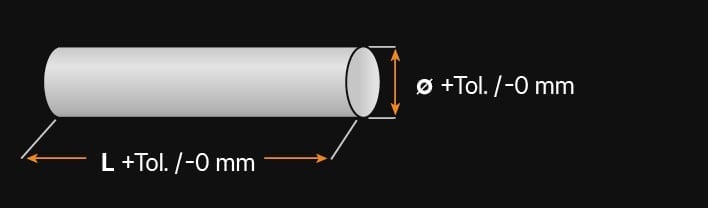
1.4031 - AT A GLANCE
What kind of steel is the 1.4031?
Material grade 1.4031 is a martensitic chromium steel, it is corrosion and acid resistant and has a good chemical resistance. It is characterised by high hardness and corrosion resistance and can be used in many different areas, such as medical technology and food technology.
Properties
The 1.4031 is a matensitic chromium steel. The combination of hardness and wear resistance make it possible to use this steel grade for mecanical engineering as well as in the food industry and many more. It can be used for decorations as well as kitchen appliances.
- Martensitic chromium steel
- Good mechanical properties
- Good polishability
- Good corrosion resistance
- Good chemical resistance
- Difficult to weld
- Limited acid resistance
Applications
With its good combination of high hardness, corrosion and wear resistance as well as a good polishability stainless steel 1.4034 can be used in many industries for even more applications.
- General engineering
- Medical technology
- Machine knives
- Shears
- Cutting tools
- Razors
- Automotive industry
- Food technology
- Fastners
- Decorative purposes
- Kitchen appliances
- Energy technology
- Springs
- Piston rods
- Screws
1.4031 Standard values
Chemical composition:
| C | Si | Mn | P | S | Cr |
|---|---|---|---|---|---|
| 0.36 - 0.42 | 0 - 1.0 | 0 - 1.0 | 0 - 0.04 | 0 - 0.015 | 12.5 - 14.5 |
Chemical designation:
X39Cr13
Working hardness:
approx. 50-55 HRC
Delivery condition:
max. 241 HB
1.4031 Physical properties
What group of steel does the 1.4031 belong to?
- Martensitic stainless steel
- Stainless steel corrosion resistant
- Stainless steel acid resistant
- Stainless steel
- Chromium steel
- Plastic mould steel
Is the 1.4031 stainless steel?
Material grade 1.4031 has a mass fraction of 12,5 – 14,5 % of chromium and is therefore a stainless steel.
Is the 1.4031 corrosion resistant?
To be classified as corrosion resistant a steel grade has to have a mass fraction of at least 10,5 % of chromium. With a chrome content of 12,5 – 14,5 % the 1.4031 is corrosion resistance.
1.4031 General corrosion resistance
Material 1.4031 is corrosion-resistant in aggressive environments such as non-chlorinated media and weak organic acids. The existing corrosion resistance can be improved by surface treatment such as polishing or coating.
Is the 1.4031 magnetisable
As a martensitic stainless steel the 1.4031 can be magnetised.
1.4031 Wear resistance
On a scale where one is low and 6 is high the 1.4031 receives a 4 for its wear resistance.
1.4031 Technical properties
Is the 1.4031 a knife steel?
Stainless steel 1.4031 has high hardness and wear resistance and is easy to machine. These properties give this material good cutting performance and make it easy to regrind. Its good corrosion resistance provides excellent protection against rust and corrosion, making it a good choice for knives such as razors or knives used outdoors.
1.4031 Working hardness
Stainless steel 1.4031 has a working hardness of 50 – 55 HRC.
1.4031 Density
At room temperature the density of the 1.4031 is 7,7 g/cm3.
1.4031 Tensile strength
The 1.4031 has a tensile strength of approx. 815 N/mm2. This value is the result of a tensile test that shows how much force is required before the material begins to stretch or deform before it breaks.
1.4031 Machinability
The 1.4031 receives a 4 for its machinability on a scale where 1 is low and 6 is high.
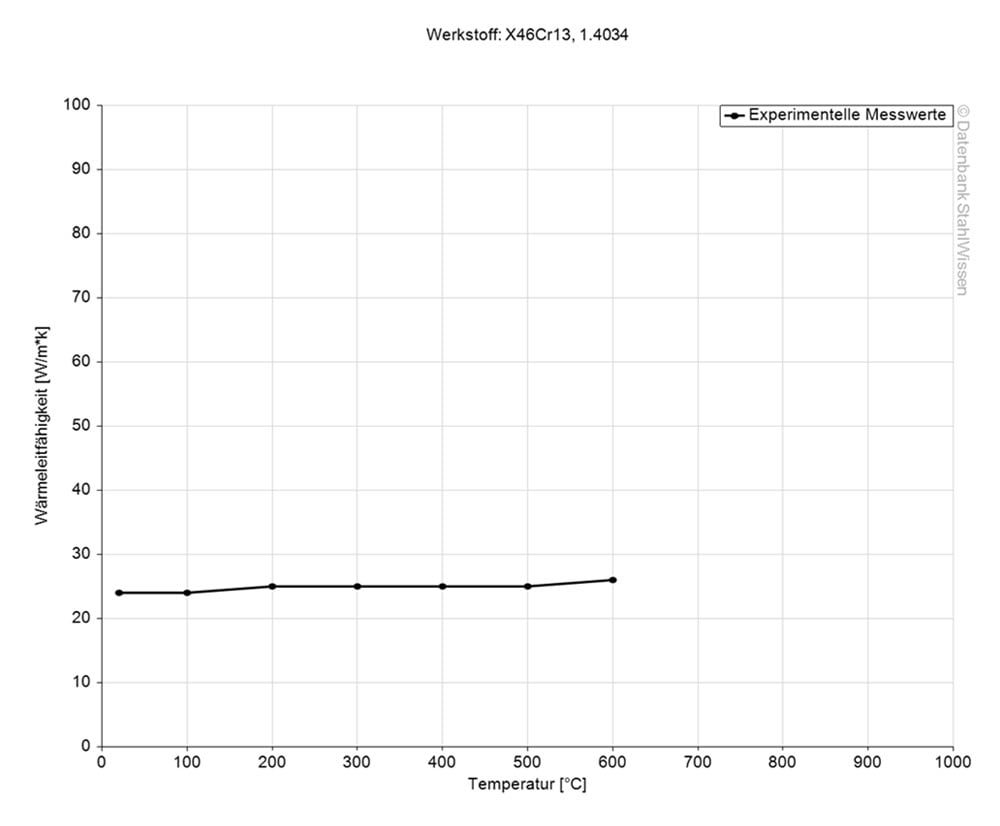
1.4031 Heat conductivity
1.4031 Thermal expansion coefficient
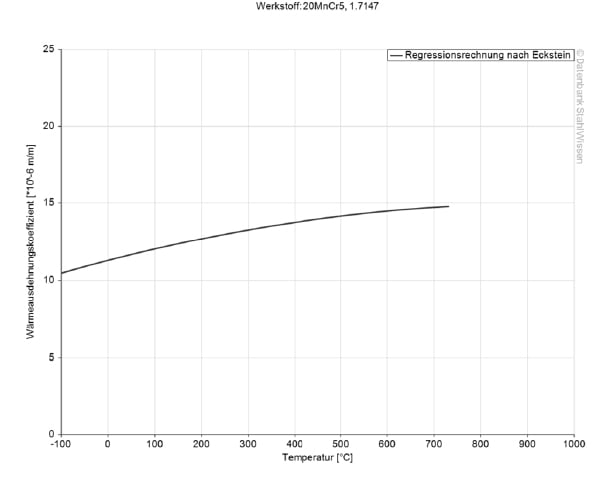
The following table shows the expansion or contraction at different temperatures, which can be very important for work at high temperatures or with significant temperature fluctuations.
Medium thermal expansion coefficient
Value tempered
10-6m/(m*K)
At a temperature of
10.5
20 – 100 °C
11.0
20 – 200 °C
11.5
20 – 300 °C
12.0
20 – 400 °C
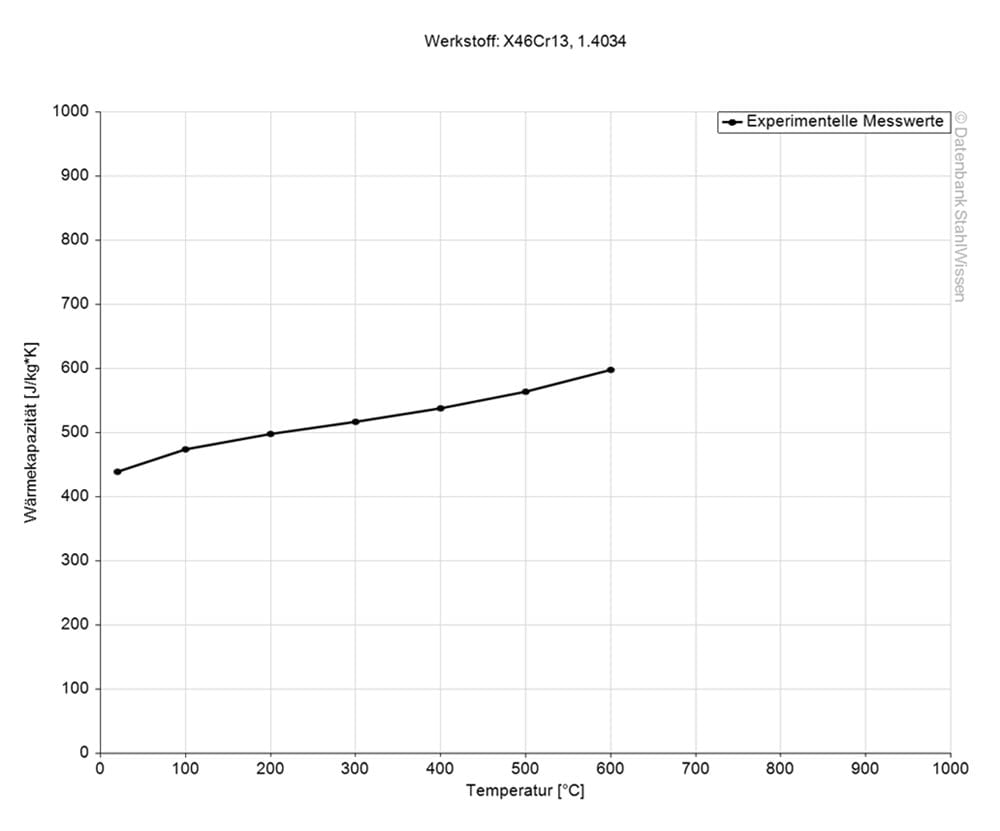
1.4031 Specific heat capacity
This value indicates how much heat is required to heat a certain amount of material by 1 Kelvin.
1.4031 Specific electrical resistance
The specific electrical resistance can be found in the following table. Electrical conductivity is the reciprocal of specific resistance.
Specific electrical resistance
Value (Ohm*mm²)/m
At a temperature of
0.65
20 °C
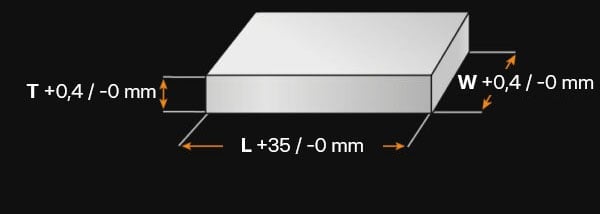
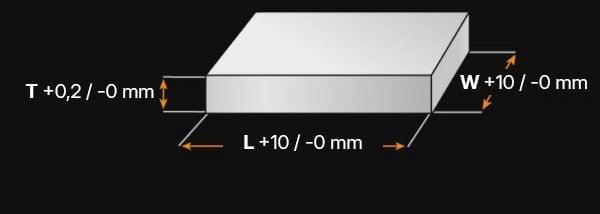
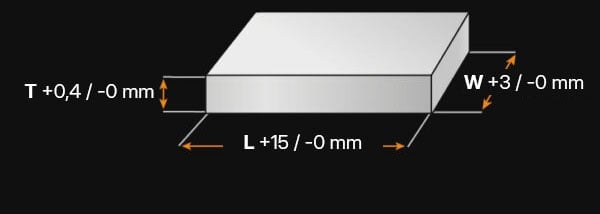
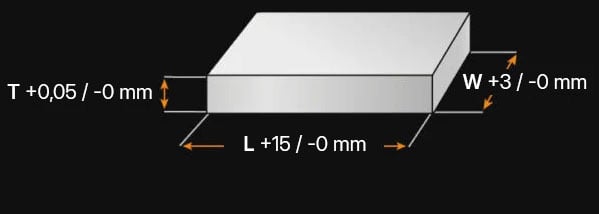
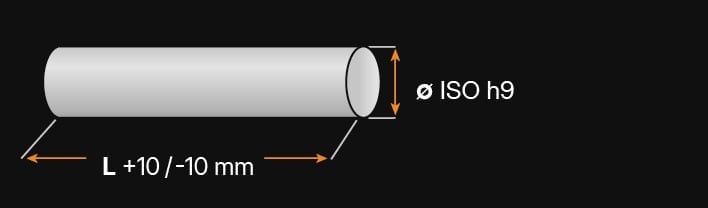
HART-PRÄZ® – ALREADY HARDENED DIMENSIONS IN LENGTH OF 250 mm AND 500 mm!
1.4031 Procedure
1.4031 heat treatment
Heat treatment is used to determine material properties. It should therefore always be carried out with care. Properties such as strength, toughness, surface hardness and temperature resistance are determined, which in turn can extend/improve the service life of parts, tools and components.
Heat treatment includes solution annealing, soft annealing, normalising, stress relief annealing, but also tempering, hardening and quenching or tempering.
1.4031 Annealing
To anneal this material heat it evenly to a temperature of 760 – 800 °C and then cool it down again in air or in the furnace.
1.4031 Stress relieving
To relieve internal stresses from the 1.4031 heat it to a temperature of 600 – 650 °C and the cool it in the furnace.
1.4031 Hardening
This stainless steel should be heated evenly to a temperature of 1000 – 1050 °C, hold it and quench it to finish of this process.
1.4031 Quenching
The 1.4031 can be quenched in the following media:
- Air
- Oil
- Water basin (500 – 550 °C)
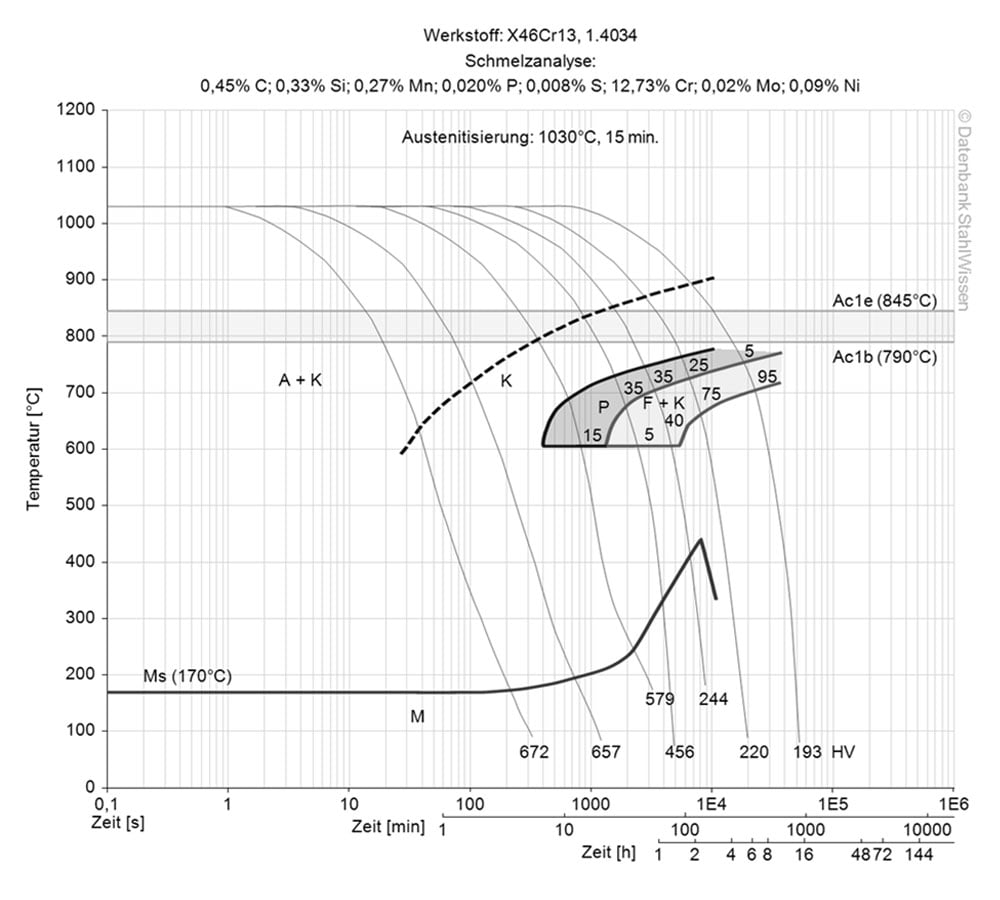
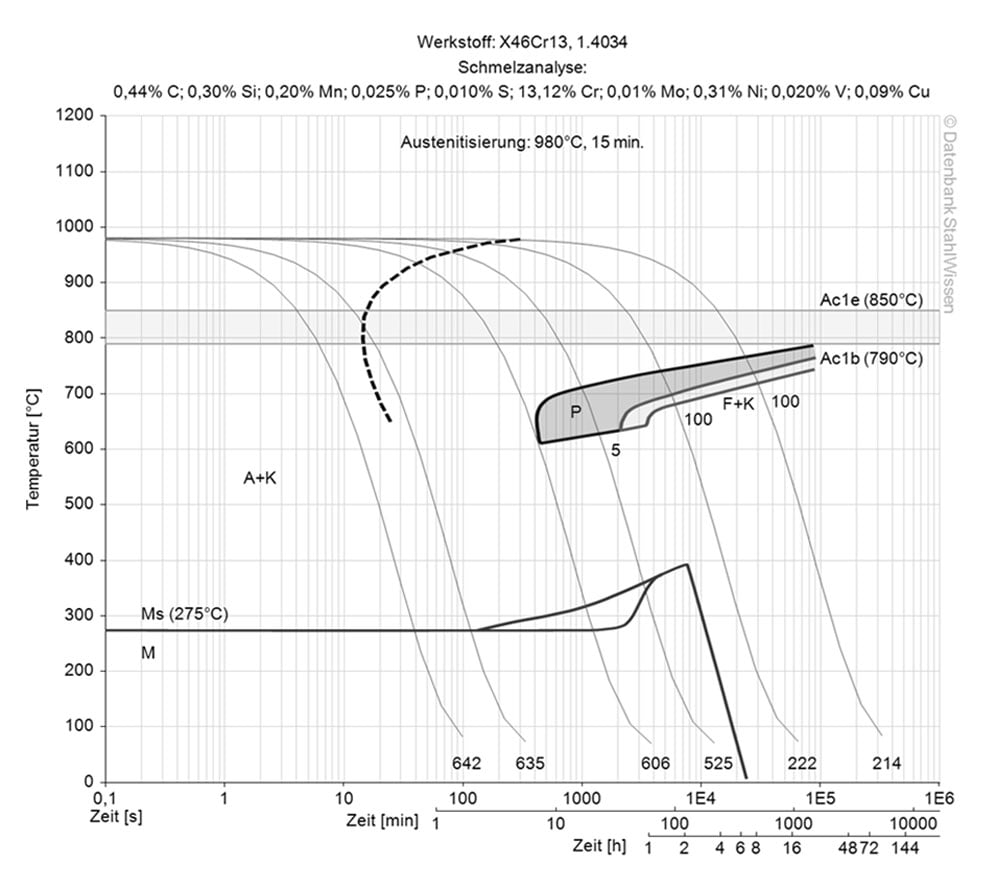
1.4031 Continuous TTT-Diagram
This diagram shows micro-changes over time at different temperatures. These are important in heat treatment because they provide information about the optimal conditions for processes such as hardening, annealing and normalising.
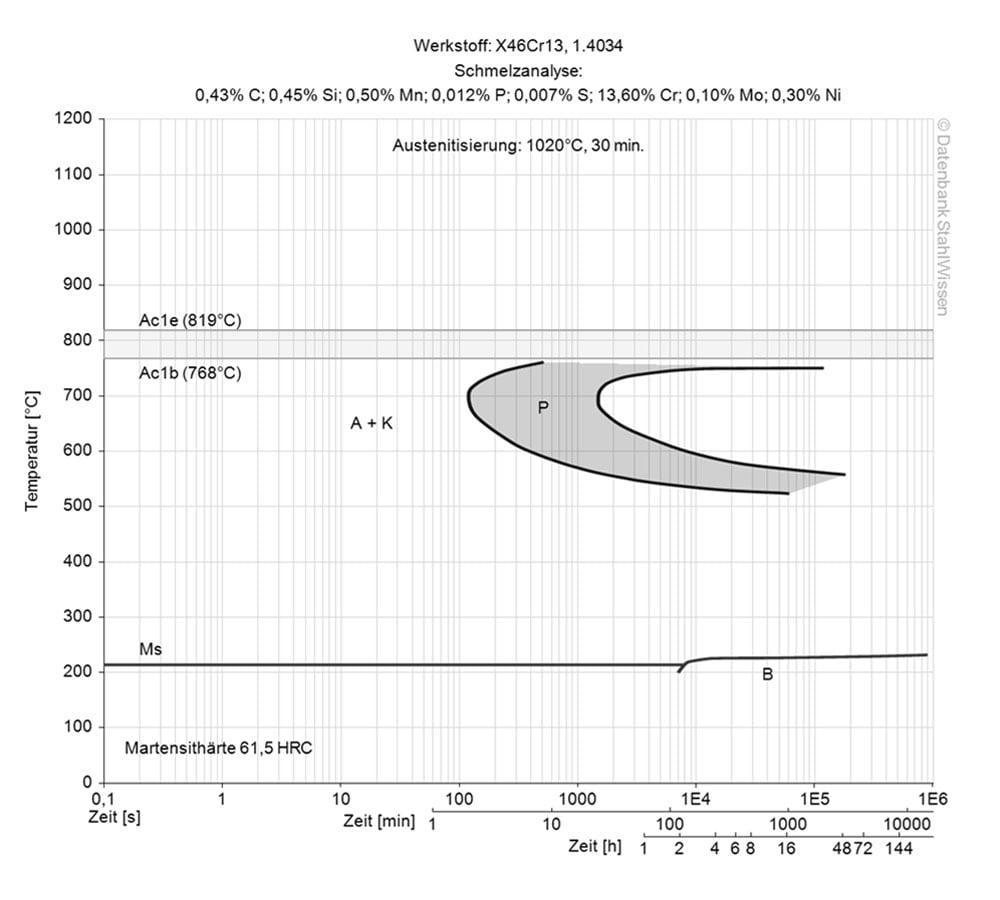
1.4031 Isothermal TTT-diagram
This diagram shows the structural changes at micro level over time at a constant temperatur. It shows at which temperatures after what time the different phases like perlit, martensite or bainite start to form.
1.4031 Surface treatment
The choice of surface treatment depends on the requirements, the environment in which the workpieces/tools are used, the required properties and the expected loads. Below are a few examples of possible surface treatments.
1.4031 Carbonitriding
This process causes nitrogen and carbon to diffuse into the surface of the metal, giving it greater hardness and wear resistance.
1.4031 Passivation
This process removes free iron from the surface using nitric or citric acid and applies a protective oxide layer to the material.
1.4031 Electropolishing
Electropolishing is a non-mechanical chemical process in which a thin layer of material is removed using an electric current to give the material a smooth and shiny surface and minimise the adhesion of bacteria, which can be beneficial in medical devices and/or food processing equipment.
1.4031 Sand and bead blasting
Abrasive particles such as sand or glass or ceramic beads are blasted against the surface to remove contaminants such as rust, paint or scale and achieve a uniform matt finish.
1.4031 Polishing
It is possible to polish this material to a high gloss. This requires several polishing processes.
Before polishing, ensure that the workpiece, tool and work area are free of particles and dust.
Tiny particles and dust grains can cause unwanted damage (pitting) to the surface of the workpiece and become entry points for more serious damage, such as pitting or cracking, but can also cause deep scratches that are not only unsightly but, in the worst case, can render the workpiece unusable.
The right polishing discs, stones and paste can produce a shiny result.
1.4031 PVD and CVD coating
Both processes, PVD and CVD, apply a thin layer to the surface of the material. This thin, hard layer gives the material wear-resistant protection.
- PVD – physical vapour deposition
- CVD – chemical vapour deposition
1.4031 Processing
1.4031 Forging
For hot forming, the 1.4031 material is heated to a temperature between 1050 and 1100 °C and should not be further processed when the temperature falls below 800 °C.
To cool down, the workpieces are placed in the furnace where they can cool slowly. Workpieces can also be placed in dry ash or similar cooling media, as these ensure that the pieces cool slowly and no new stresses are built up.
After forging, the workpieces should be heat treated to restore the microstructure and relieve internal stresses.
1.4031 Welding
In general, welding this steel grade is very difficult. If repairs are necessary, it must be ensured that this material is an air-hardening chrome steel and is only welded using suitable methods, additives and electrodes in order to carry out the necessary repairs.