PREMIUM 1.2344 Steel
X40CrMoV5-1

BS BH 13

PREMIUM 1.2344 Steel
X40CrMoV5-1

X40CrMoV5-1

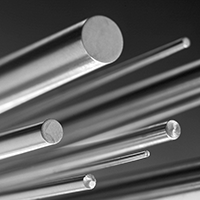
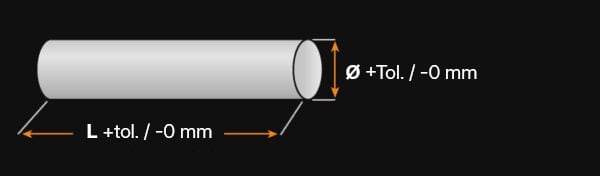
Precision round steel with machining allowance [PRS/BA]

- round -
Toleranzen.png

1.2344  - AT A GLANCE

What kind of steel is the 1.2344?

The 1.2344 Steel (X40CrMoV5-1) is a hot work steel. It can be water cooled, oil or air hardened and has a good toughness. The 1.2344 is a 5% chromium tool steel that hardens in air and is versatile enough for a broad range of hot and cold work uses. The added vanadium increases the resistance to abrasion and imparts superior properties at elevated temperatures.

Tool Steel 1.2344 is often used in cold work tools because of its exceptional toughness, even though it might slightly reduce wear resistance. Apart from its high temperaturr resistance and thermal cracking resistance, it also has high polishability and is suitable for lens and cutlery molds. 

Properties

Tool Steel 1.2344 has some advantages and disadvantages. Although it has a certain corrosion resistance, it should be well cared for to prevent rust. The 1.2344 does not lend itself for making knives as it cannot hold its sharpness at the cutting edge, even though its hardness makes it easy to resharpen.

Although this steel is better suited for hot work, it can also be cold worked. The 1.2344 has high temperature stability, good resistance to thermal fatigue and good toughness and wear resistance.

  • Good high-temperature strength
  • High hot wear resistance (a bit higher than the 1.2343)
  • High thermal shock resistance
  • Very good toughness
  • Can be easily eroded and nitrided
  • Water coolable
  • Fire crack resistant
  • For even better toughness and the highest purity and homogeneousness use 1.2344 ESR

Applications

The 1.2344 has a multitude of good properties which makes this tool steel not only a good choice for high temperatures but in combination with its thermal fatigue and abrasion resistance can be used for casting and extrusion tools, as well as for dies, hot shear blades and stamping tools to name just a few. With its good resistance to thermal fatigue, erosion and wear, it is ideal for plastic moulds.

  • Forging tools and dies
  • Hot shear knives
  • Hot extrusion tools
  • Extrusion press tools
  • Press tools
  • Block receivers
  • Die casting tools
  • Light metal die casting
  • Press mandrels
  • Press dies
  • Piecer plugs
  • Screw production
  • Rivet production
  • Bolts production
  • Ejectors
  • Plastic molds

1.2344 Standard values

Chemical composition:

C Si Mn P S Cr Mo V
0.35 - 0.42 0.8 - 1.2 0.25 - 0.5 0.0 - 0.03 0.0 - 0.02 4.8 - 5.5 1.2 - 1.5 0.85 - 1.15

Chemical designation:
X40CrMoV5-1

Working hardness:
50-56 HRC

Delivery condition:
max. 229 HB

1.2344 Physical properties

  • Tool steel
  • Hot work steel
  • Plastic mould steel

Although 1.2344 contains a mass fraction of 4.8–5.5% chromium, it is not stainless steel in the traditional sense. Stainless steel contains a minimum of 10.5% chromium.

Although 1.2344 offers a certain degree of corrosion resistance, if corrosion resistance is a key requirement, it is advisable to choose a stainless steel grade or apply a protective coating.

Yes, as a ferrous metal, 1.2344 can be magnetised. Grinding, milling and eroding can be carried out on machines with magnetic adhesion, for example.

Hot work steel, such as 1.2344, can be continuously exposed to high temperatures. It has high strength, hardness, thermal stability, toughness and wear resistance for a longer service life.

Cold working the 1.2344 material is easier in the annealed state. Heat treatment is challenging due to its hardness, and the parts can become hardened, which in turn can lead to breakage and wear. In order to relieve the stresses introduced and give the workpieces their final properties, they should then be heat treated.

On a scale where 1 is low and 6 is high the 1.2344 receives a 3 for its wear resistance.

1.2344 Technical properties

Tool steel 1.2344 is not usually used as a knife steel even with its hardness and ability to be sharpened well it does not hold the edge very well or long.

The hardness for the 1.2344 is at about 50 – 56 HRC.

The density for tool steel 1.2344 at room temperature is approx. 7,74 g/cm³.

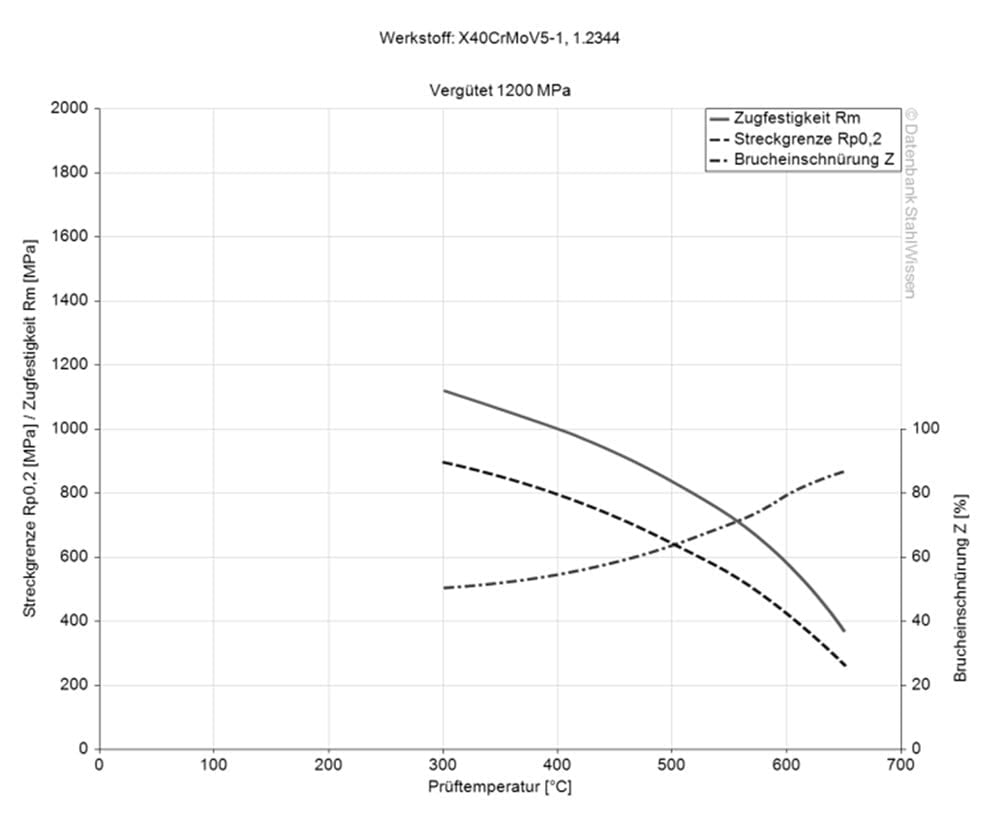
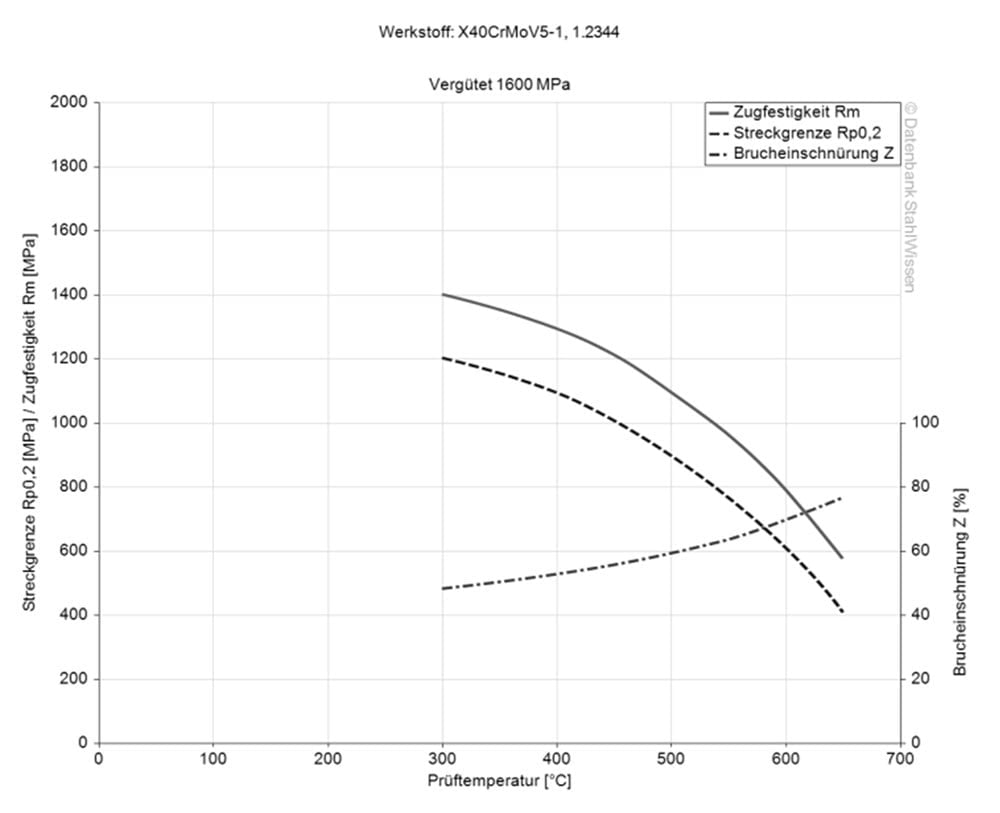
The 1.2344 has a tensile strength of approx. 770 N/mm² in its delivery condition. To determine this value, a material sample is subjected to a tensile test to determine how much force is required to stretch or elongate the sample before it breaks.

The yield strength indicates how much stress a material can withstand before it becomes irreversibly deformed. Before reaching this point, the 1.2344 material will return to its original shape when the stress is removed. After this point, the material remains deformed or even breaks. The yield strength for 1.2344 tool steel is approximately 1650 N/mm2.

On a scale where 1 is low and 6 is high, material 1.2344 receives a 4 for its machinability.

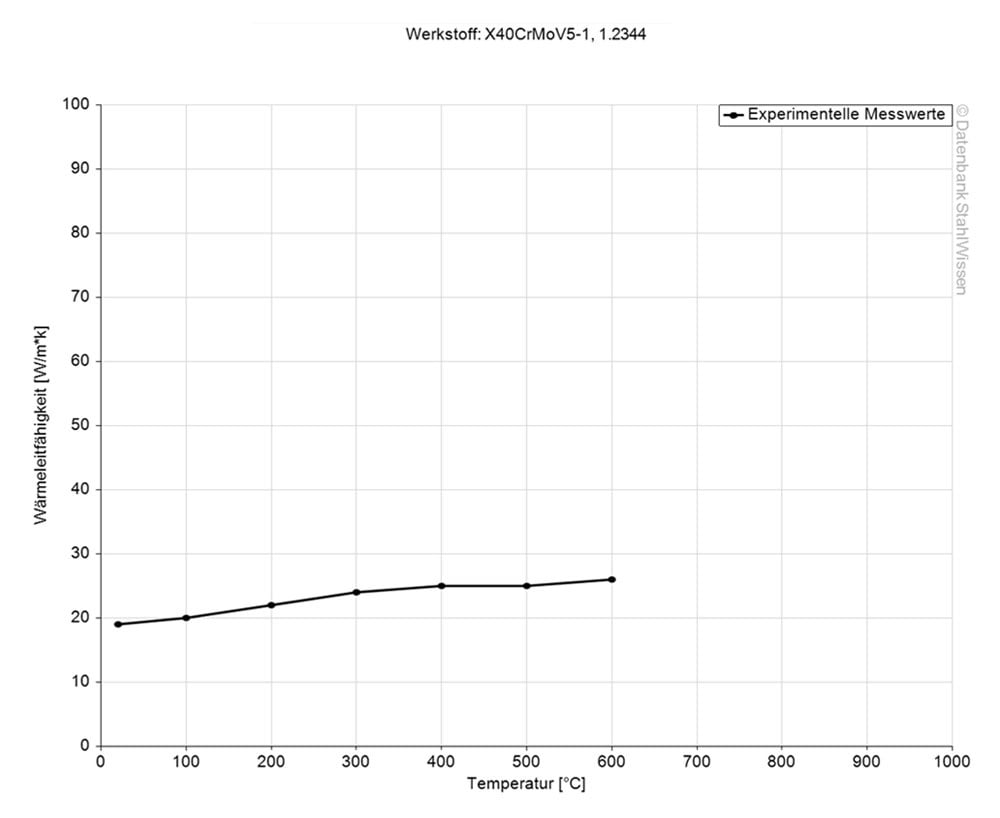
The following table shows the thermal conductivity of material 1.2344 in its annealed and hardened state.

Heat conductivity

Value, annealed
W/(m*K)
Value, hardened
W/(m*K)

At a temperature of

27.2

25.5

 20 °C

30.5

27.6

350 °C

33.4

30.3

700 °C

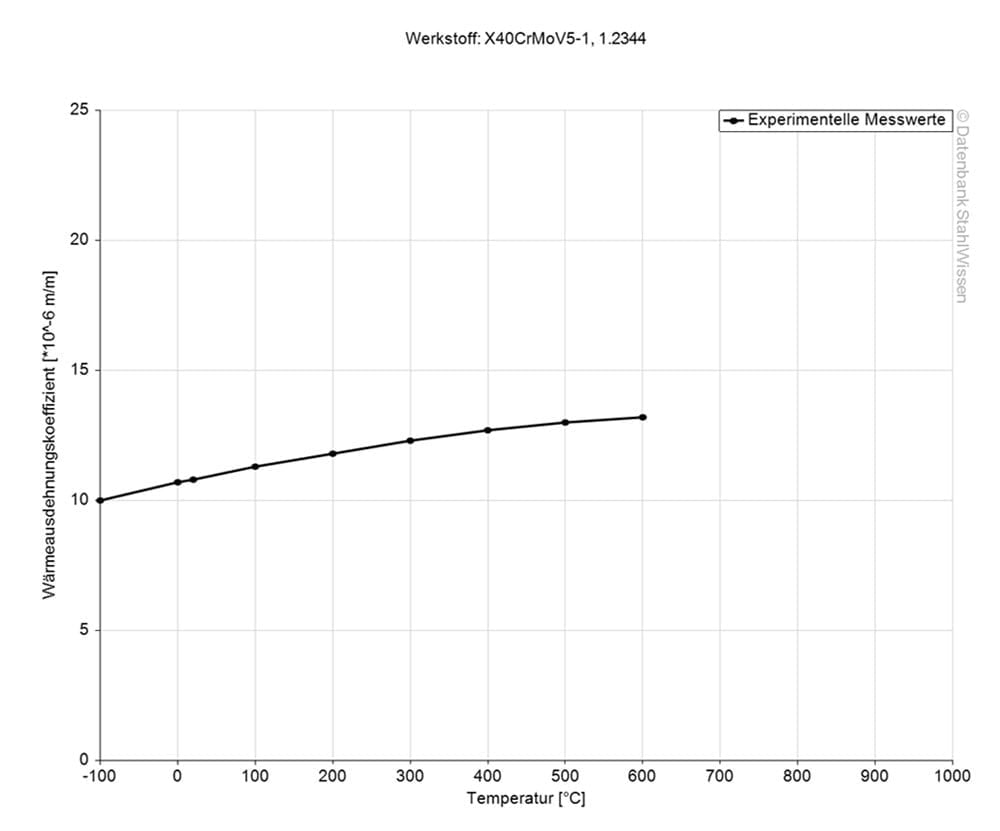
This diagram shows how much material 1.2344 expands or contracts when exposed to temperature changes. This information can be important when tools are exposed to high or fluctuating temperatures.

Medium thermal expansion coefficient

Value 10-6m/(m*K)

At a temeprature of

10.9

20 – 100 °C

11.9

20 – 200 °C

12.3

20 – 300 °C

12.7

20 – 400 °C

13.0

20 – 500 °C

13.3

20 – 600 °C

13.5

20 – 700 °C

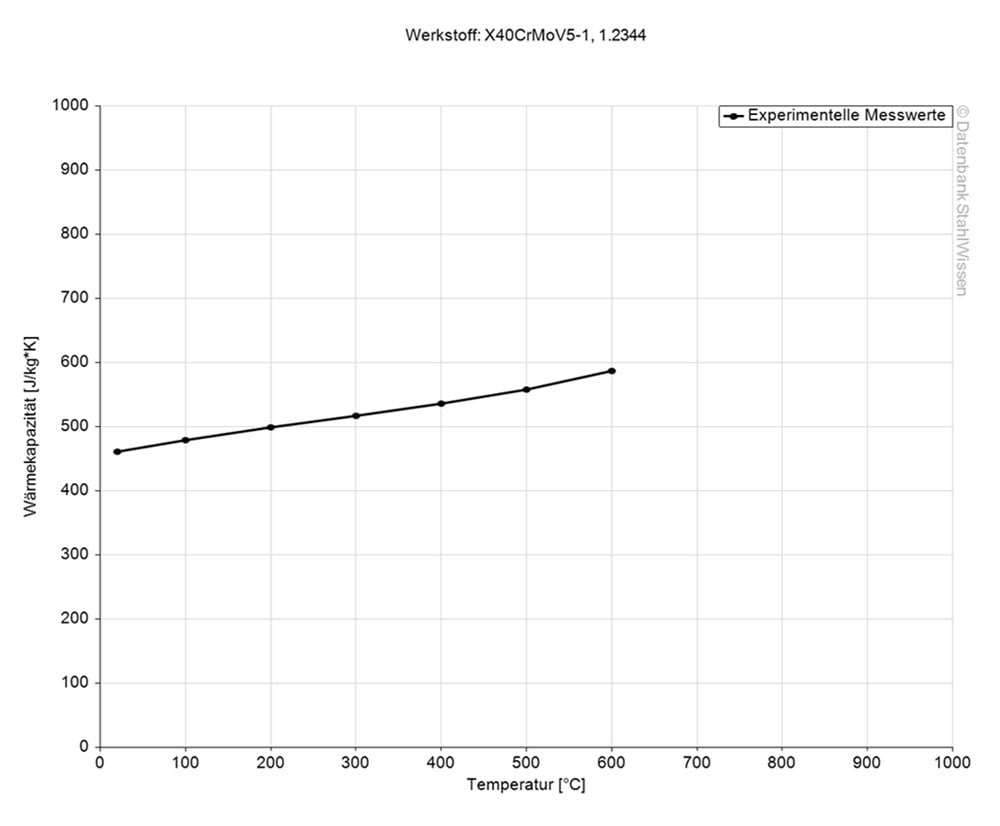
The specific heat capacity of 1.2344 at room temperature is 0.46 J/kg*K.

The specific heat capacity is a physical property of 1.2344 and indicates how much heat is required to heat a specific amount of material by 1 Kelvin.

The temperature dependent material constant (specific electrical resistance) can be found in the following table.

Electrical conductivity is the reciprocal of the specific electrical resistance.

Specific electrical resistance

Value (Ohm*mm2)/m

At a temperature of

~ 0.543  

~ 20 °C

~ 0.638

~ 100 °C

~ 0.705

~ 200 °C

~ 0.782

~ 300 °C

~ 0.868

~ 400 °C

~ 0.960

~ 500 °C

~ 1.060

~ 600 °C

BECOME EVEN BETTER WITH ABRAMS PREMIUM STEEL® THAN YOUR COMPETITORS SUSPECT!

1.2344 Procedure

The heat treatment process determines the properties of the material. It should therefore always be carried out with care. Properties such as strength, toughness, surface hardness and temperature resistance are determined, which in turn can extend/improve the service life of parts, tools and components.

Heat treatment includes solution annealing, soft annealing, normalising, stress relief annealing, but also tempering, hardening and quenching or tempering.

To prevent surface damage, 1.2344 should be annealed in a neutral atmosphere or in a suitable container using neutral annealing charcoal.
For annealing, 1.2344 is heated slowly and evenly to a temperature of 750–800 °C.
The temperature is then reduced by approx. 10–20 °C per hour to 600 °C, after which the material can cool further in air.

After rough machining, or in case of extensive machining, stress relief annealing is required for 1.2344 in order to prevent deformation caused by induced stresses. The tool steel is stress relief annealed at a temperature of 600 – 650 °C.

The temperature is maintained for 1–2 hours in a neutral atmosphere and then cooled in a controlled manner in air. Controlled cooling is important to prevent new stresses from building up.

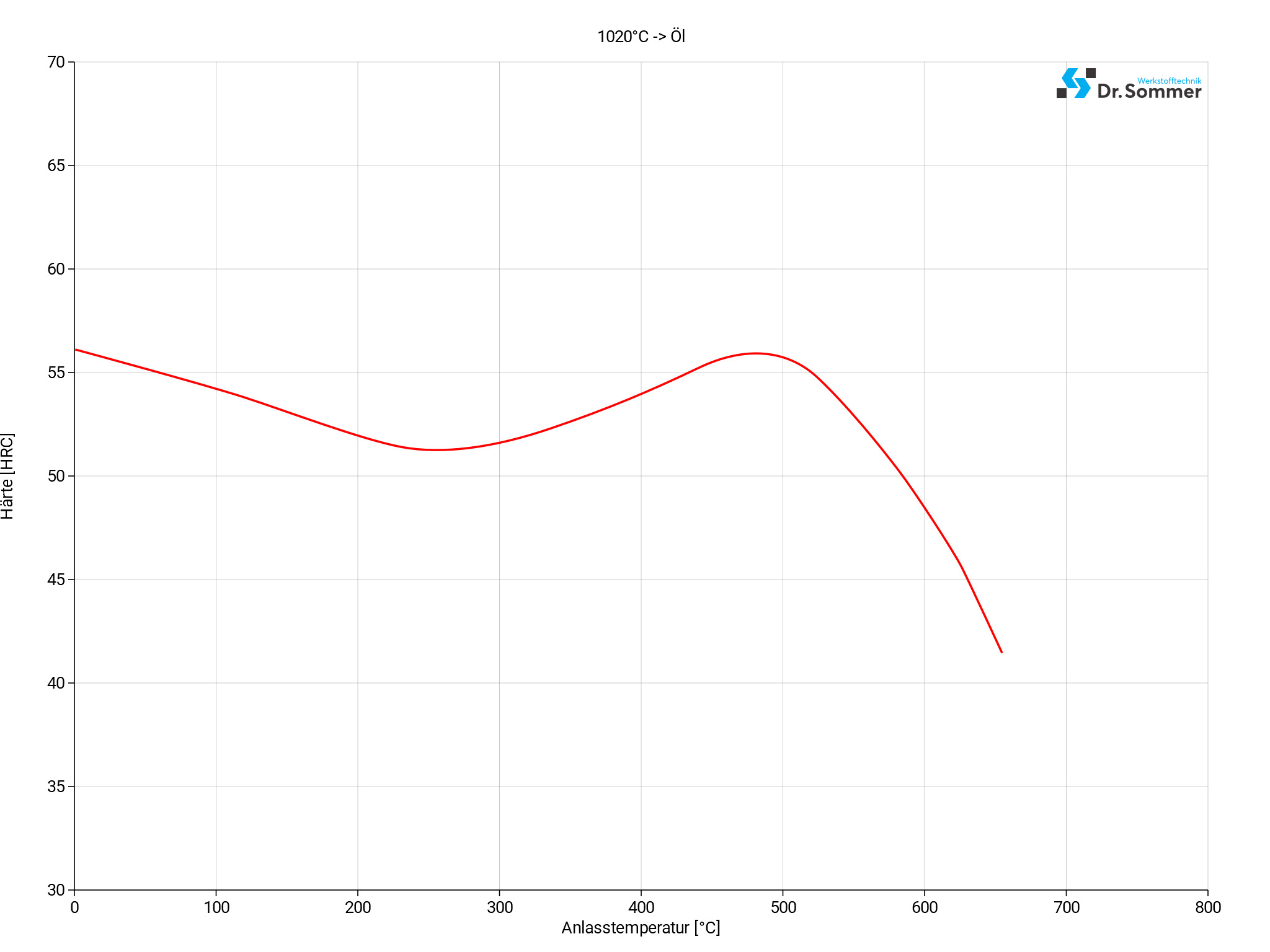
Immediately after hardening, the material is slowly brought to the tempering temperature and held there for at least 1 hour per 25 mm thickness. The tempering temperature should be at least 10 °C above the expected working temperature of the tool.

Workpieces should be tempered twice; a third tempering process can be beneficial for reducing stress in the workpiece.

Hardening tool steel 1.2344 gives it better properties.
To control decarburisation, use a controlled atmosphere furnace or pack the 1.2344 in an inert material. Heat it evenly to a temperature of 1020 – 1060 °C, hold the temperature for 15 – 30 minutes, quench the material and then let it cool directly.

The 1.2344 is usually cooled in air, although it can also be cooled with other substances. Factors such as application, shape and size of the workpieces should be taken into account when choosing the cooling method.

  • Air
  • Oil
  • Vacuum
  • Hot bath

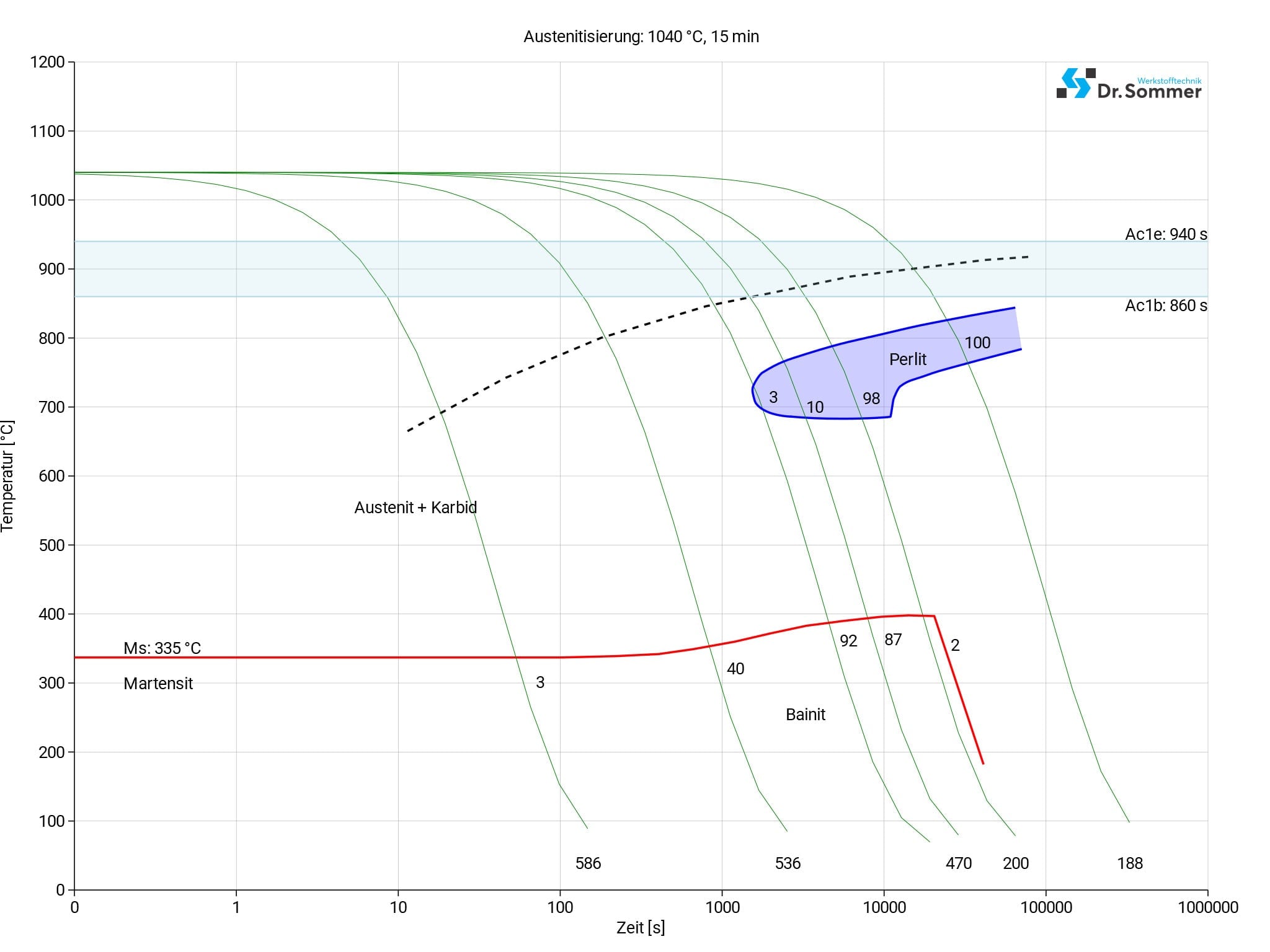
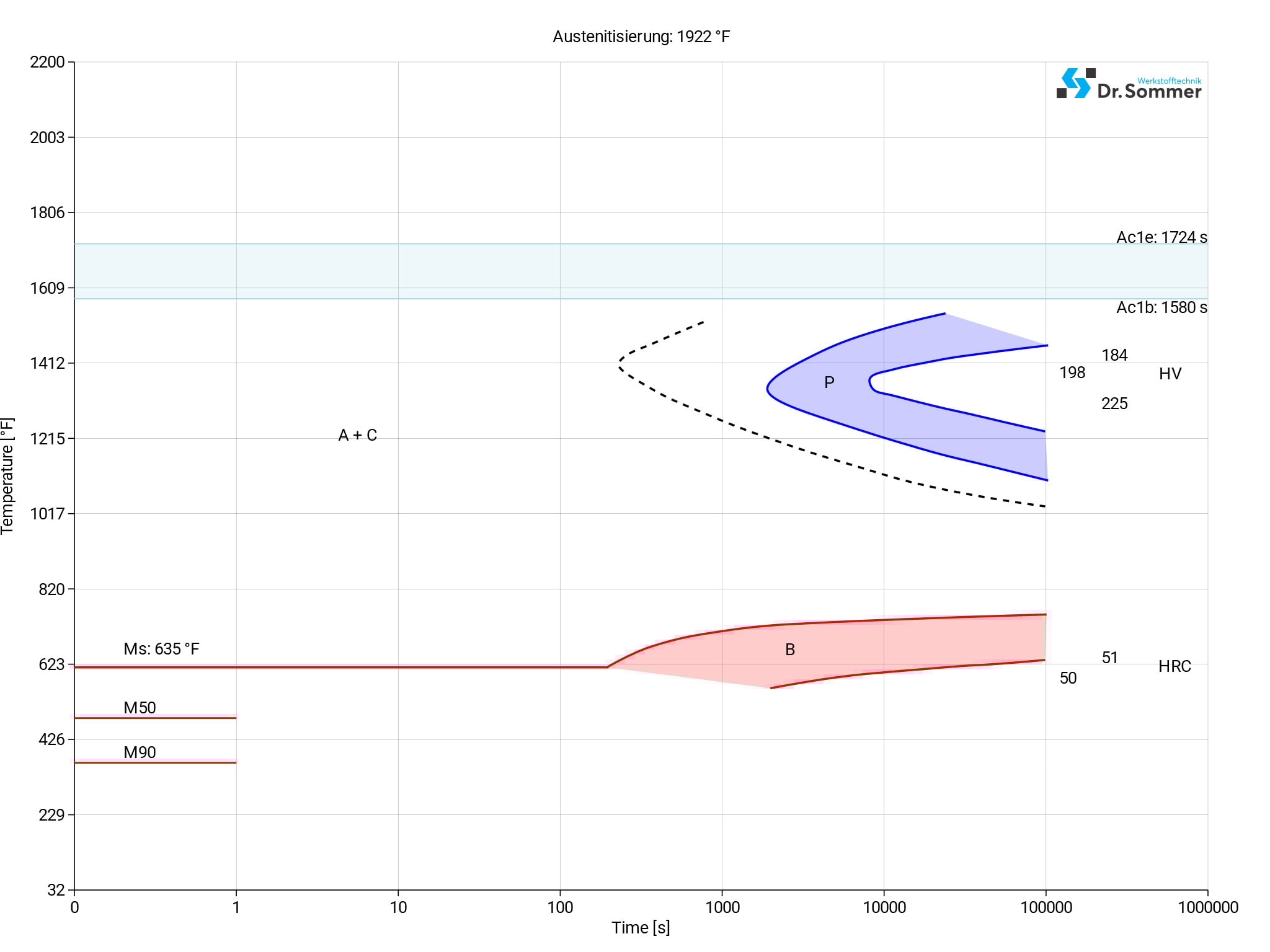
This diagram shows micro-changes over time at different temperatures. These are important in heat treatment because they provide information about the optimal conditions for processes such as hardening, annealing and normalising.

This diagram shows the structural changes at micro level over time at a constant temperatur. It shows at which temperatures after what time the different phases like perlit, martensite or bainite start to form.

1.2344 Surface treatment

Die folgenden Angaben sind nur ein Beispiel für eine Vielzahl von Oberflächenbehandlungen für den Werkzeugstahl 1.2344. Die Wahl der Oberflächenbehandlung hängt von der Anwendung ab, für die die Werkstücke verwendet werden sollen.

To improve wear resistance and fatigue strength, grade 1.2344 can be nitrided. This process involves introducing nitrogen into the surface, which results in a certain degree of corrosion resistance, but can also reduce the need for frequent lubrication of moving parts.

Although this process is not as commonly used for this grade as nitriding, it introduces carbon into the material surface and gives it additional surface hardness with a tough core.

During this process, workpieces and tools are given a black mixed oxide coating that provides a certain degree of corrosion protection. This process is also used to give workpieces an aesthetic appearance, but also to give workpieces that are exposed to light a surface with low reflectivity, for example.

To reduce friction and improve wear resistance and corrosion resistance, 1.2344 can be coated using the PVD (Physical Vapour Deposition) or CVD (Chemical Vapour Deposition) processes. In both processes, a very thin layer of material is applied to the surface of the workpieces.

1.2344 Processing

The 1.2344 can be machined by erosion in its annealed or hardened condition.

Tempering after erosion may be necessary, as the heat-affected zones may have different properties to the base material. With the correct settings and under optimal conditions, the 1.2344 tool steel can achieve a very smooth surface through erosion.

Like other tool steels, tool steel 1.2344 retains its size best when quenched at an exact hardening temperature. If overheated, the material tends to shrink after tempering and should therefore be avoided.

Tool steel 1.2344 can be treated below the freezing point. Instead of tempering the material after hardening, it is cooled to temperatures below zero and held there to convert the residual austenite into martensite.

The advantages for 1.2344, in addition to a refined carbide structure, are increased hardness and wear resistance, as well as improved dimensional stability. In order to relieve any new stresses that may have been introduced, the cryogenic treatment should be followed by tempering as described above.

The material is heated slowly and evenly to a temperature of 1035 – 1120 °C. When forging this material, the temperature should not fall below 900 °C; it can be brought back to forging temperature as required.

Cool small and simple parts slowly in lime. Larger parts should be cooled evenly to a temperature of 790 °C in a heated furnace, then switch off the furnace and allow the parts to cool slowly.

Please note that this is not annealing; annealing should be carried out after the forged parts have cooled down.

When welding tool steel, good results can be achieved if the right precautions are taken (increased working temperature, preparation of the joint, choice of welding consumables and welding process). If the workpieces are polished or photo-etched, it is necessary to work with a suitable type of electrode with the appropriate composition.

Logo_Abrams_Ausrufezeichen.png
BECOME EVEN BETTER WITH ABRAMS PREMIUM STEEL® THAN YOUR COMPETITORS SUSPECT!

ALTERNATIVES

Are you looking for an alternative steel grade?

With the ABRAMS STEEL GUIDE®, you are able to obtain an alternative or equvelent with just a few clicks.

DATASHEET

Download the technical data sheet in PDF format here.

Messe.png

SERVICES

Do you require special dimensions?


Our services for you: water jet cutting, sawing, milling and grinding.

richtwerte-2.png

Standard values

Chemical designation: X40CrMoV5-1
Working hardness: 50-56 HRC
Delivery condition: maximum 229 HB
Chemical composition:
C Si Mn P S Cr Mo V
0.35

0.42
0.8

1.2
0.25

0.5
0

0.03
0

0.02
4.8

5.5
1.2

1.5
0.85

1.15
technical-info.png

Technical properties

Hot work steel with excellent heat resistance and high wear resistance (slightly higher than BS BH 11). Good toughness and thermal conductivity. Can be cooled with water and is resistant to thermal shock.

anwendungen.png

Applications

Forging tools and dies, hot shear knives, hot extrusion tools, extrusion press tools, press tools, block receivers, die casting tools, light metal die casting, press mandrels, press dies, piecer plugs, screw production, rivet production, bolts production, ejectors, plastic moulds.

70 STEEL GRADES IN 32.895 DIMENSIONS

EX WORKS FROM OSNABRÜCK

DELIVERY IN 3-5 WORKING DAYS (SUBJECT TO AVAILABILITY)

WITHOUT MINIMUM ORDER VALUE OR QUANTITY

FROM EUROPE'S LARGEST RANGE OF SEMI-FINISHED PRODUCTS

SPECIAL CUSTOM DIMENSIONS SAWN - MILLED - GROUND

Select Your Country / Language

Do you have any questions?

If you have any comments or questions regarding ABRAMS PREMIUM STEEL® products or this website, please do not hesitate to contact us.

Please feel free to call us at any time:

T: +44 121 368 0910

or send us an E-mail to:

[email protected]

If you have any comments or questions regarding ABRAMS PREMIUM STEEL® products or this website, please do not hesitate to contact us.

Please feel free to call us at any time: