
1.2709 ESR - AT A GLANCE

What kind of steel is the 1.2709 ESR?
The tool steel 1.2709 ESR is a high-alloy martensitic hardening tool steel with high toughness, and is characterised by low distortion, high hardness and strength. 1.2709 ESR can be easily machined in the annealed and hardened state. As an ESR steel (electroslag remelted steel), 1.2709 ESR has a homogeneous and purer microstructure. It has a high yield strength and high tensile strength, which makes it suitable in many different industries.

Properties
The high-alloy 1.2709 ESU can be used in many different industrial sectors thanks to its positive properties. The combination of hardness, wear resistance and toughness gives this steel a good performance and service life, which is particularly needed in the automotive and aerospace industry, but also in mould making. In these industries, workpieces and tools have to withstand high stresses.
- Tool steel
- Precipitation hardening
- High-strength
- Very good toughness
- High yield strength
- High tensile strength
- Low dimensional change
- Minimal distortion

Applications
Tool steel 1.2709 ESR is used in many different industries for a variety of applications. Here are a few examples of where 1.2709 ESR can be used.
In mould making, it is used for injection moulding tools that are needed when manufacturing injection moulded parts. In the automotive and aerospace industries, this material is used for forming sheet metal or cutting other materials. Thanks to its high wear resistance, it is widely used in mechanical engineering to manufacture tools. Its high wear resistance, toughness and machinability make it possible to manufacture tools that can withstand high loads, breaks and cracks, thereby extending the service life of the tools.
- Pressing punches
- Cold heading punches
- Gear cutting punches
- Cold heading tools
- Coining tools
- Pressing dies
- Hot pressing dies
- Hot pressing tools
- Tool holders
- Cutting punch
- Pressure casting moulds (for light metals)
- Plastic moulds
- Reinforcements
- Light metal processing
- Shear blades
- Mouthpieces
- Distributor pins
- Cores
- Slide valves

1.2709 ESR STANDARD VALUES
Chemical composition:
| C | Si | Mn | P | S | Cr | Mo | Ni | Ti | Co |
|---|---|---|---|---|---|---|---|---|---|
| 0.0 - 0.03 | 0.0 - 0.1 | 0.0 - 0.15 | 0.0 - 0.01 | 0.0 - 0.01 | 0.0 - 0.25 | 4.5 - 5.2 | 17.0 - 19.0 | 0.8 - 1.2 | 8.5 - 10.0 |
Chemical designation:
X3NiCoMoTi18-9-5
Working hardness:
51-56 HRC
Delivery condition:
max. 325 HB
1.2709 ESR Physical Properties
What group of steel does the 1.2709 ESR belong to?
- Tool steel
- Plastic mould steel
- Cold work steel
- Hot work steel
- Maragin steel
Why ESR material?
Electroslag remelting, or ESR, also known as electric flux remelting, is a process in which steel is remelted and passed through a slag that removes debris and impurities from the steel. What remains is steel with a higher degree of purity and a finer, more homogeneous structure. The reduction in impurities in the steel gives it greater integrity, as there are fewer weak points. ESR steel can exhibit better mechanical properties, such as higher tensile strength, yield strength, toughness, wear resistance, better surface finish and longer tool life.
Is the 1.2709 ESR a stainless steel?
No, tool steel 1.2709 ESR is not stainless steel in the traditional sense. To be classified as stainless steel, the steel must have a minimum chromium content of 10.5%. 1.2709 ESR has a mass fraction of up to 0.25%.
Is the 1.2709 ESR corrosion resistant?
The tool steel 1.2709 ESR is rated 3 for corrosion resistance on a scale where 1 is low and 6 is high.
Is the 1.2709 ESR magnetisable?
Yes, 1.2709 ESR is a martensitic steel and can be magnetised. Grinding, milling and eroding can be carried out on machines with magnetic adhesion, for example.
1.2709 ESR Wear resistance
The tool steel 1.2709 ESR is rated 4 on a scale of 1 to 6 for wear resistance.
1.2709 ESR Technical Properties
Is the 1.2709 ESR a knife steel?
1.2709 ESR has good properties that make it suitable for knife manufacturing. It has high hardness, toughness and wear resistance. These are properties that are required for the cutting performance, resharpenability and break resistance of a knife. Although this grade has a certain degree of corrosion resistance, it may be advantageous to carry out surface treatment and clean the knife regularly to prevent rust formation and ensure a longer service life.
1.2709 ESR Working hardness
The working hardness for material 1.2709 ESR is 51-56 HRC.
1.2709 ESR Steel density
Typically, the density of 1.2709 ESR tool steel is 8.1 g/cm3 at room temperature.
1.2709 ESR Tensile strength
The tensile strength for 1.2709 ESR is approx. 1.100 N/mm2. This value is the result of a tensile test that shows how much force is required before the material begins to stretch or deform before it breaks.
1.2709 ESR Machinability
Tool steel 1.2709 ESR is rated 4 for machinability on a scale where 1 is low and 6 is high.
1.2709 ESR Heat conductivity
The thermal conductivity for 1.2709 ESR is 18.4 W/(m*K) at 23°C.
Heat conductivity
Value
At a temeprature of
18.4
23 °C
20.4
150 °C
22.7
300 °C
23.2
350 °C
23.5
400 °C
24.0
500 °C
1.2709 ESR Thermal expansion capacity
The following table shows the expansion or contraction at different temperatures, which can be very important for work at high temperatures or with significant temperature fluctuations.
Medium thermal expansion coefficient
10-6m/(m*K)
At a temeprature of
10.1
20 – 100 °C
10.5
20 – 200 °C
10.9
20 – 300 °C
11.1
20 – 350 °C
11.3
20 – 400 °C
11.5
20 – 450 °C
11.8
20 – 500 °C
1.2709 ESR Specific heat capacity
The specific heat capacity of 1.2709 ESR at room temperature is 0.42 J/g • K. This value indicates how much heat is required to heat a specific amount of material by 1 Kelvin.
1.2709 ESR Specific electrical resistance
The specific electrical resistance can be found in the following table. Electrical conductivity is the reciprocal of specific electrical resistance.
Table of the specific electrical resistivity
Value (Ohm*mm²)/m
At a temperature of
0.42
20 °C
SUPERIORITY!


1.2709 ESR Procedure
1.2709 ESR Heat treatment
Heat treatment is used to determine material properties. It should therefore always be carried out with care. Properties such as strength, toughness, surface hardness and temperature resistance are determined, which in turn can extend/improve the service life of parts, tools and components.
Heat treatment includes solution annealing, soft annealing, normalising and stress relief annealing, but also tempering, hardening and quenching or tempering.
1.2709 ESR Annealing
For soft annealing, the 1.2709 ESU is heated evenly to a temperature of 850 – 1100°C. The material is then cooled in the furnace.
1.2709 ESR Solution annealing
In order to restore a homogeneous structure after forging or welding, 1.2709 ESR is heated to a temperature of 800°C and held there for approx. one hour. The material is then cooled in air or a gas stream.
Solution annealing is also used before precipitation hardening.
1.2709 ESR Precipitation hardening
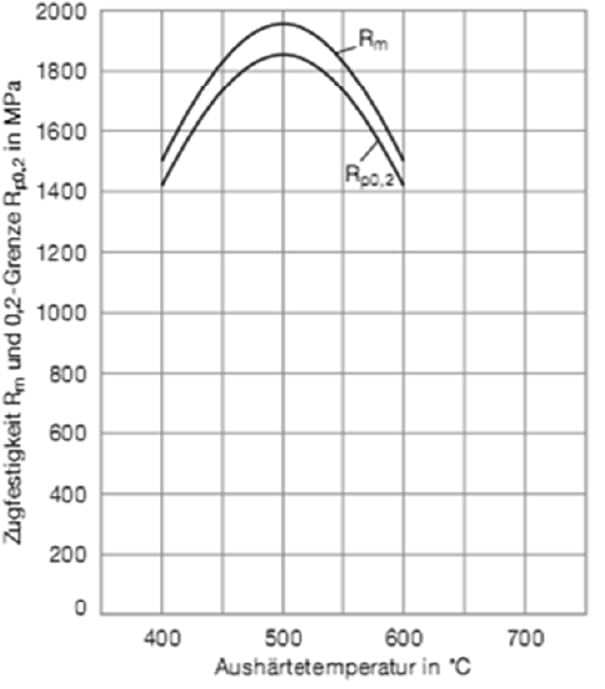
To increase strength, 1.2709 ESR can be subjected to an age hardening process.
To achieve a strength of 1720 – 1870 N/mm2, the material is heated evenly to a temperature of 430°C, held for 3 hours and then cooled in air.
To achieve a strength of 1860 – 2260 N/mm2, the material is heated evenly to a temperature of 480°C, held for 3 hours and then cooled in air.
1.2709 ESR Hardening
The 1.2709 ESR is heated evenly to a temperature of approx. 490°C and quenched in air.
1.2709 ESR Quenching
- Air

1.2709 ESR Surface treatment
1.2709 ESR Nitriding
In this process, nitrogen is diffused into the surface of the material. The resulting nitriding layer increases surface hardness and wear resistance and improves corrosion resistance.
1.2709 ESR Plasma nitriding
In plasma nitriding, nitrogen is diffused into the surface using a plasma gas. A uniform glow discharge ensures consistent hardness, even on complex parts.
1.2709 ESR Hard chrome plating
For improved wear resistance or corrosion resistance, the surface of 1.2709 can be coated with a layer of hard chrome.
1.2709 ESR PVD and CVD
These processes apply a thin layer to the material. The layer gives the material improved surface hardness, wear resistance and lubrication.
- PVD – physical vapour deposition
- CVD – chemical vapour deposition

1.2709 ESR Processing
1.2709 ESU Bearbeitungsaufmaß / Maßänderungen
During heat treatment, dimensional changes such as warping or dimensional changes caused by internal stresses may occur in material 1.2709 ESU. During cooling, care should be taken to cool the material evenly, as otherwise it may warp. To avoid dimensional changes, precise heat treatment and machining, as well as stress relief, should be carried out.
1.2709 ESU Forging
The material is heated evenly to a temperature of 850–1100°C to forge the 1.2709 ESR. After forging, the material should be cooled down in the furnace.