
1.6580 - AT A GLANCE

What kind of steel is the 1.6580?
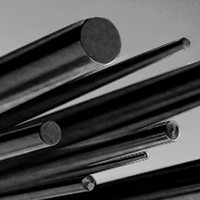
The material 1.6580 (here in the tempered condition), also known as 30CrNiMo8, is a CrNiMo-alloyed construction steel. Due to its good mechanical properties, such as its strength and toughness, it is often used for components that are subject to high stresses. When fully hardened, it is used for components in engine and machine construction. Usually components are used in the tempered delivery condition.

Properties
This material offers a good balance between strength, toughness and machinability, making it a good choice for a range of industries and applications.
- Heat-treatable steel
- High strength
- High toughness
- Components can be used in the tempered delivery condition
- Can be nitrided to a surface hardness of 60 – 64 HRC

Applications
The material 1.6580 is used for components that require a high level of strength and toughness. Components are usually used in a tempered delivery state. However, the material can also be hardened very well and can then also be used for components in car manufacturing or in mechanical engineering.
- Fasteners
- Mechanical engineering
- Gears
- Shafts
- Axles
- Bolts
- Automotive engineering / engine construction
- Crankshafts
- Camshafts
- Gear parts

1.6580 Standard values
Chemical composition:
| C | Si | Mn | P | S | Cr | Mo | Ni |
|---|---|---|---|---|---|---|---|
| 0.26 - 0.34 | 0.0 - 0.4 | 0.3 - 0.6 | 0.0 - 0.025 | 0.0 - 0.035 | 1.8 - 2.2 | 0.3 - 0.5 | 1,. 2.2 |
Chemical designation:
30CrNiMo8
Working hardness:
max. 41 HRC
Delivery condition:
max. 380 HB
1.6580 Physical properties
What group of steel does the 1.6580 belong to?
- Heat-treatable steel
- High grade structural steel
Is the 1.6580 a stainless steel?
To be classified as a stainless steel a steel grade has to have a mass fraction of at least 10,5% of chromium. With a mass fraction of 1,8 – 2,2 % the 1.6580 is not a stainless steel in the classical sense.
Is the 1.6580 corrosion resistant?
The corrosion resistance of a steel starts with a mass fraction of at least 10,5% of chromium. The 1.6580 has a mass fraction of 1,8 – 2,2 % of chromium and is not corrosion resistant.
Is the 1.6580 magnetisable?
As a ferro magnetic steel grade the 1.6580 is magnetisable. This makes it suitable for magnetic clamping.
Wear resistance 1.6580
On a scale where 1 is low and 6 is high the 1.6580 receives a 3 for its wear resistance.
1.6580 Technical properties
Is the 1.6580 a knife steel?
The carbon content of the 1.6580 is not high enough to be able to reach the needed hardness and cutting edge. This makes this steel grade not suitable as a knive steel.
1.6580 Working hardness
The working hardness for the heat-treatable steel 1.6580 is at approx. 60 – 64 HRC.
1.6580 Density
The typicall density for the 1.6580 at room temperature is at 7,76 g/cm3.
1.6580 Tensile strength
The tensile strength for the heat-treatable steel 1.6580 is approx. 1200 N/mm2. This value is the result of a tensile test that shows how much force is required before the material begins to stretch or deform before it breaks.
1.6580 Yield strength
Yield strength
Dimension
Value
<= 16 mm
>= 1050 MPa
17 – 40 mm
>= 1050 MPa
41 – 100 mm
>= 900 MPa
101 – 160 mm
>= 800 MPa
1.6580 Machinability
For its machinability the 1.6580 receives a 3 on a scale where 1 is low and 6 is high.
1.6580 Heat conductivity
At room temperature the heat conductivity of the 1.6580 is at 38,0 W/(m*K).
1.6580 Thermal expansion coefficient
The coefficient of thermal expansion indicates how much the material can expand or contract when the temperature changes. This is very important information, especially when working with high temperatures or when there are significant temperature fluctuations during use.
Medium thermal expansion coefficient
Value 10-6m/(m*K)
At a temperature of
11.5
20 – 100 °C
12.5
20 – 200 °C
13.3
20 – 300 °C
13.9
20 – 400 °C
1.6580 Specific heat capacity
The specific heat capacity for stainless steel 1.6580 at room temperature is 0,43 J/kg*K. This value indicates how much heat is required to heat a certain amount of material by 1 Kelvin.
1.6580 Specific electrical resistance
The specific electrical resistance for the 1.6580 can be found in the following table. Electrical conductivity is the reciprocal of specific resistance.
Specific electrical resistance
Value (Ohm*mm²)/m
At a temperature of
0.19
20 °C
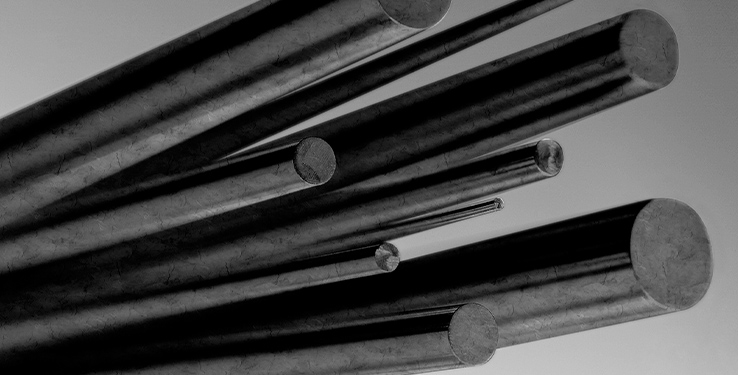
ROUND STEEL – IN BLACK!

1.6580 Procedure
1.6580 Heat treatment
The heat treatment determines material properties. It should therefore always be carried out with care. Properties such as strength, toughness, surface hardness and temperature resistance are determined, which in turn can extend/improve the service life of parts, tools and components.
Heat treatment includes solution annealing, soft annealing, normalising, stress relief annealing, but also tempering, hardening and quenching or tempering.
1.6580 Normalising
Heat the 1.6580 to a temperature of 850 – 880 °C to normalise it and finish the process with a cooling in air.
1.6580 Annealing
To anneal the 1.6580 heat it to a temperature of 650 – 700 °C and then let it cool down slowly in the furnace.
1.6580 Tempering
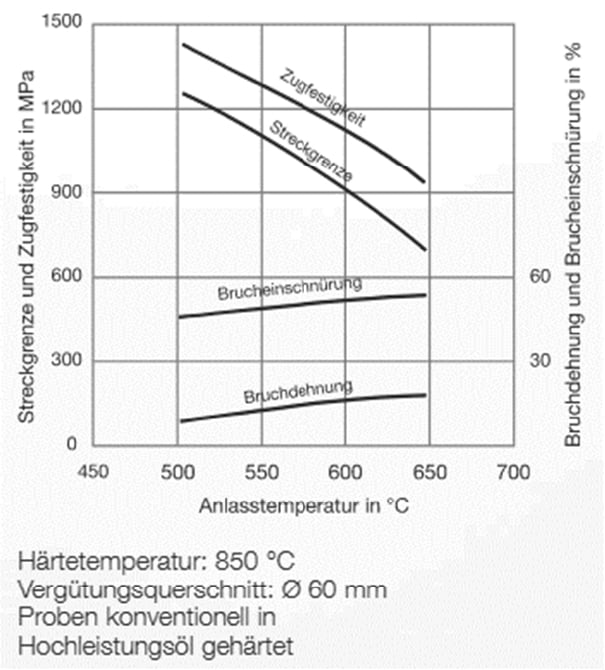
Heat the material evenly to a temperature of 540 – 680 °C and hold it there for at least 1 hour. Follow this with a cool down in air.
For more information please take a look at the following chart.
1.6580 Hardening
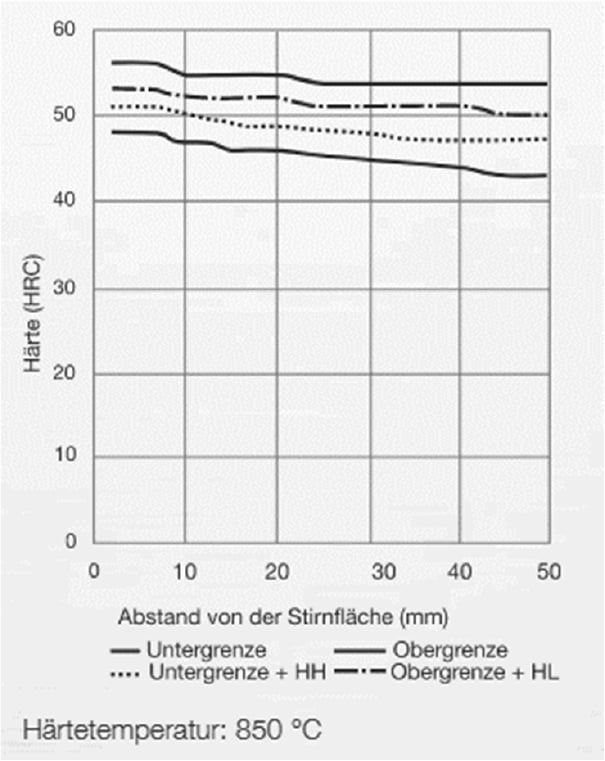
To harden work pieces made from the 1.6580 heat them evenly to a temperature of 830 – 860 °C. To finish this process of the work pieces are quenched.
1.6580 Quenching
The 1.6580 can be quenched in the following media:
- Oil
- Polymer
- Water
- Air

1.6580 Surface treatment
1.6580 Nitriding
During nitriding, nitrogene is diffused into the surface of the steel. This gives the steel a harder and more wear resistant surface and can improve service life and corrosion resistance.
1.6580 Carburising
Carbon is being diffused into the surface of the 1.6580 to give it a harder and more wear resistant surface.
1.6580 Induction hardening (casehardening)
Induction hardening is a fast, selective and targeted heating of the surface of a workpiece. The surface is heated by the electrical resistance of the material using induction (alternating electrical voltage).
Various inductors are used to heat the material surface in a focused manner, thereby hardening specific areas of the workpiece. This allows highly stressed areas and even complex geometries to be hardened.
After induction hardening, the material is immediately quenched.
1.6580 Phosphate coating
In this process, a phosphate solution is sprayed onto the component or it is immersed in a phosphate solution. The resulting phosphate layer on the component improves corrosion resistance and can also form the basis for further coating, such as painting.
1.6580 Black oxide coating or blueing
Before oxidation, the material surface is thoroughly cleaned of deposits and adhesions and then immersed in an alkaline aqueous salt solution.
Black oxidation, also known as blueing, is a surface finish that reduces surface reflection and can increase corrosion resistance.
1.6580 Galvanised coating
Galvanising is an electrochemical process in which a layer of chrome, nickel or zinc, to name but a few, is applied to the workpiece. This increases the corrosion resistance and wear resistance of the coated workpieces.

1.6580 Processing
1.6580 Electrical Discharge Machining (EDM)
In general, a material is eroded in order to produce workpieces from a single piece. Erosion can be used to produce dies or more complex shapes. There are various methods of eroding different materials, such as wire erosion, spark erosion or die-sinking erosion.
1.6580 Forging
To forge the 1.6580 it is heated to a temeprature of 850 – 1100 °C and then forged. This process is finished by letting the finished forging cool evenly and slowly in the furnace.
1.6580 Welding
The material 1.6580 is only suitable for welding to a limited extent and should therefore not be used for welded constructions.