1.7225 +QT - AT A GLANCE
What kind of steel is the 1.7225 +QT?
As a low alloyed steel the 1.7225 +QT (here in its tempered condition) relys on the alloyed chromium, molybdenum and manganese to elevate its strength and hardenability, yet it has inadequate weldability characteristics.
While the chromium content in this heat treatable steel provides through-hardenability, the added molybdenum provides even hardness and strength.
The addition of manganese lends this steel an elevated strength and hardenability. 1.7225 +QT (also known as the 42CrMo4 +QT) can be used for both high and low temperature applications and with the relevant heat treatment can be used in sour gas environments.
Properties
As a a low-alloy chromium-molybdenum steel the 1.7225 +QT, also know as the 42CrMo4 +QT, is characterised by its high strength, good toughness and hardenability. It finds its uses in mechanical engineering, toolmaking and many industries due to its good properties.
- Excellent wear resistance
- Excellent load-bearing capacity
- Good machinability
- High strength
- High toughness
- Nitridable
- Erodible
- Difficult to weld
Applications
For the 1.7225 +QT application can include:
- Mandriles
- Flanges
- Collets
- Bending dies
- Crankshafts
- Clutch parts
- Forming rolls
- Short run stamping dies
- Mechanical engineering
- Machine parts
- Axes
- Knuckles
- Connecting rods
- Crankshafts
- Gear shafts
- Pinions
- Gears
- Bandages
- Base plates
- Assembling parts
1.7225+QT Standard values
Chemical composition:
| C | Si | Mn | P | S | Cr | Mo |
|---|---|---|---|---|---|---|
| 0.38 - 0.45 | 0.0 - 0.4 | 0.6 - 0.9 | 0.0 - 0.035 | 0.0 - 0.035 | 0.9 - 1.2 | 0.15 - 0.3 |
Chemical designation:
42CrMo4+QT
27 (min. hardness/delivery condition) – 48 HRC
max. 270 HB, tempered (flat) /
max. 380 HB, tempered (round)
1.7225+QT Physical properties
Was für ein Stahl ist der 1.7225+QT?
Als ein niedrig legierter Stahl ist der 1.7225+QT (hier in gehärteter Ausführung) auf den Zusatz von Chrom, Molybdän und Mangan angewiesen, um die Festigkeit und Härtbarkeit zu erhöhen. Er weist jedoch unzureichende Schweißbarkeits-Eigenschaften auf. Der Chromgehalt dieses Vergütungsstahls sorgt für die Durchhärtung, während das beigefügte Molybdän für gleichmäßige Härte und Festigkeit sorgt.
Das zugesetzte Mangan eignet sich zur Erhöhung der Festigkeit und Härtbarkeit. 1.7225+QT Stahl (42CrMo4+QT) kann sowohl für Nieder- als auch für Hochtemperaturanwendungen verwendet werden und kann mit der entsprechenden Wärmebehandlung auch in Sauergasumgebungen eingesetzt werden.
Wofür steht QT?
What group of steel does the 1.7225+QT belong to?
- Heat-treatable steel
- Cold work steel
- High grade structural steel
Is the 1.7225+QT a stainless steel?
Despite containing chromium and molybdenum, 1.7225+QT is not a classic 10.5% chromium stainless steel. It belongs to the group of high-quality structural steels.
Is the 1.7225+QT corrosion resistant?
On a scale where 1 is low and 6 is high the 1.7225+QT receives a 2 for its corrosion resistance.
Is the 1.7225+QT magnetisable?
Heat-treatable 1.7225+QT is magnetisable which makes it suitabe for magnetic clamping for machining, milling and grinding for example.
1.7225+QT Hot work
This steel can be hot worked at 816 – 1038 °C and retains its properties even after prolonged exposure to high working temperatures.
1.7225+QT Cold work
When annealed, this steel can be cold-formed using all conventional methods.
1.7225+QT Wear resistance
The 1.7225+QT receives a 3 for its wear resistance on a scale where 1 is low and 6 is high.
1.7225+QT Technical properties
Is the 1.7225+QT a knife steel?
When manufacturing a knife or blade from 1.7225+QT, hardness, corrosion resistance and wear resistance should be taken into account. Although possible, this type of steel is not normally used for manufacturing knives.
1.7225+QT Working hardness
The working hardness of the 1.7225+QT is in the range of 27 – 48 HRC.
1.7225+QT Density
At room temperature the 1.7225+QT is at 7,85 g/cm3.
1.7225+QT Tensile strength
1.7225+QT has a tensile strength of approx. 720 N/mm². To obtain these findings, a tensile test is carried out to show how much force is required to stretch or elongate a sample before it breaks.
1.7225+QT Yield strength
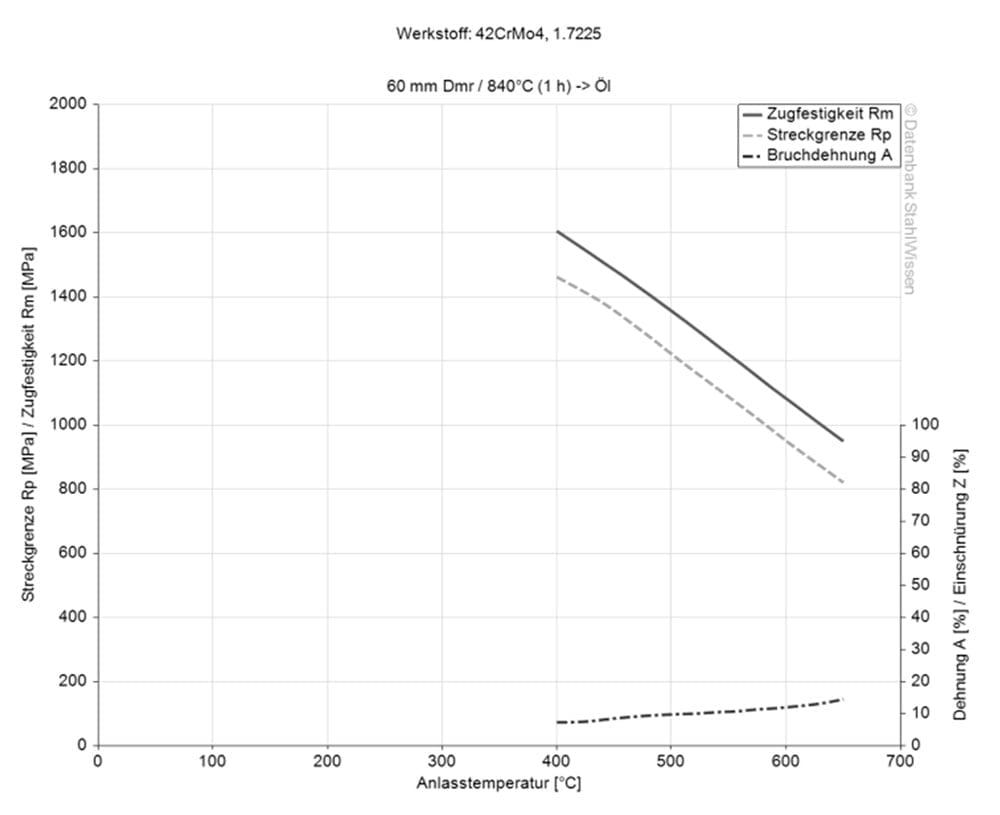
The yield strength for the 1.7225+QT is approximately 655 N/mm2. It indicates how much stress can be applied before a material undergoes plastic deformation. Beyond this point, the material will not return to its original shape when the stress is removed, but will remain deformed or even break.
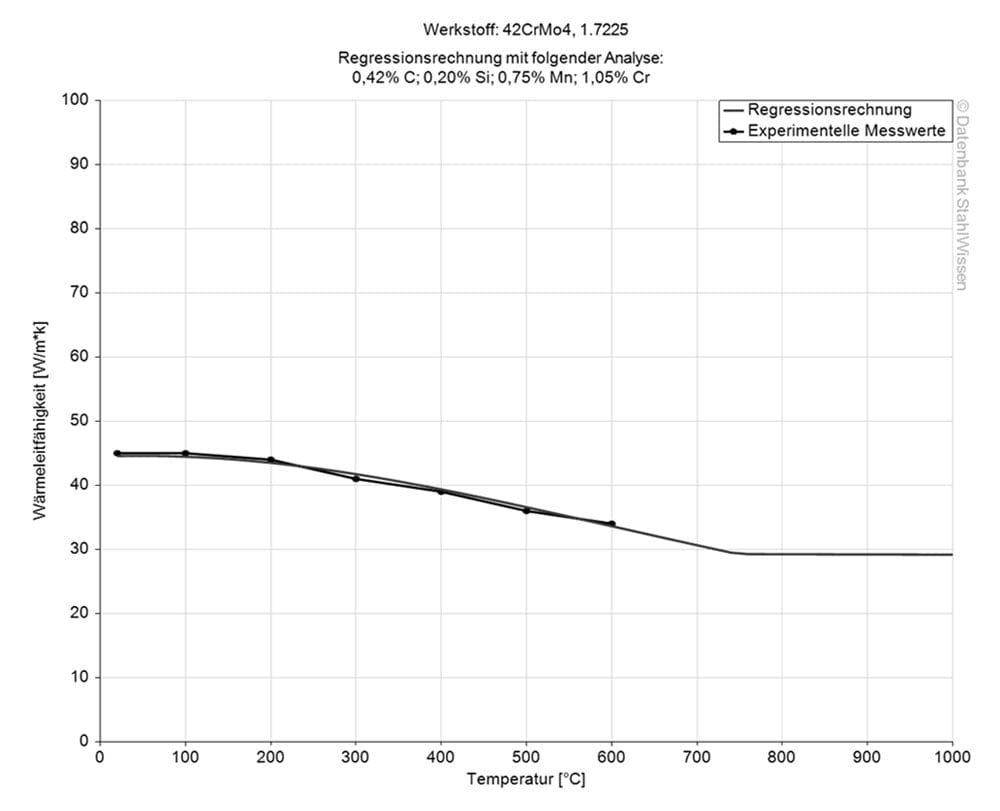
1.7225+QT Heat conductivity
The heat conductivity for the 1.7225+QT at room temperature is at 42,6 W/(m*K).
Heat conductivity
Value W/(m*K)
At a temperature of
42.6
20 °C
1.7225+QT Thermal expansion coefficient
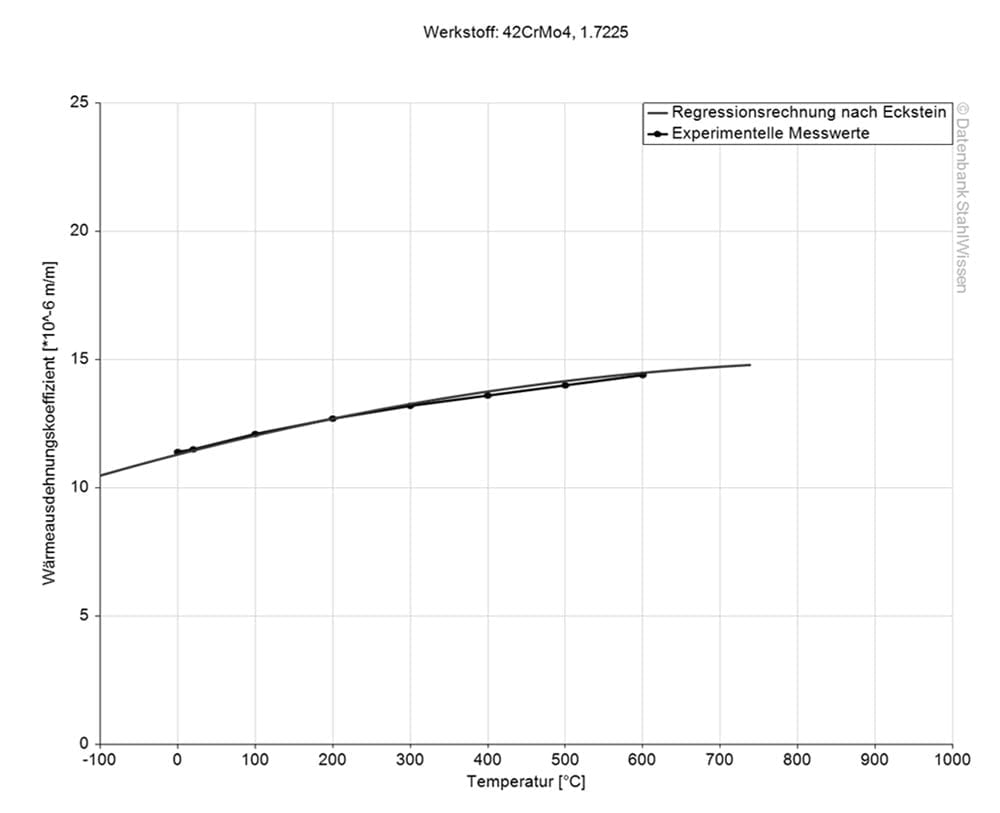
The coefficient of thermal expansion indicates how much the material can expand or contract when the temperature changes. This is veery important information, especially when working with high temperatures or when there are significant temperature fluctuations during use.
Medium thermal expansion coefficient
Value 10-6m/(m*K)
At a temeprature of
11.1
20 – 100 °C
12.1
20 – 200 °C
12.9
20 – 300 °C
13.5
20 – 400 °C
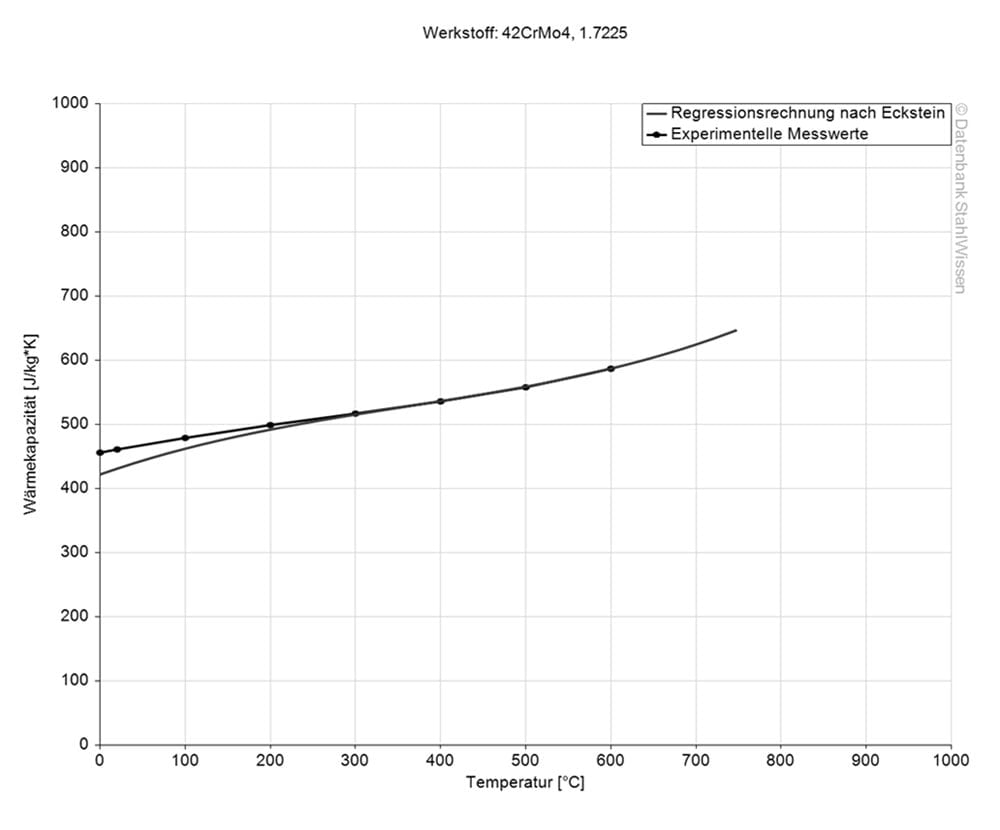
1.7225+QT Specific heat capacity
The value of the specific heat capacity shows how much heat is needed to heat a specific amount of material by 1 Kelvin.
1.7225+QT Specific electrical resistance
The following table shows the specific electrical resistance. Electrical conductivity is the reciprocal of electrical resistivity.
Table of the specific electrical resistivity
Value (Ohm*mm2)/m
At a temperature of
~ 0.231
~ 20 °C
~ 0.284
~ 100 °C
~ 0.358
~ 200 °C
~ 0.448
~ 300 °C
~ 0.552
~ 400 °C
~ 0.671
~ 500 °C
PASSION!
1.7225+QT Procedure
1.7225+QT Heat treatment
Material 1.7225+QT can be heat to a temperature of 860 °C and is then quenched in oil. By normalising and tempering the 1.7225+QT can achieve a good range of properties.
1.7225+QT Annealing
Heat the workpieces evenly to a temperature of 680 – 720 °C which is followed up with a slow cooling in the furnace to achieve a hardness of 217 HB.
1.7225+QT Stress relieving
Heat the 1.7225+Qt to a temperature of 593 – 705 °C and hold for 2 hours on the chosen temperature before cooling it in air.
1.7225+QT Normalising
This steel grade can benormalised before hardening. Heat the steel to a temperature of 840 – 880 °C and then let it cool down in air.
1.7225+QT Tempering
Generally, hardness and ductility are determined by tempering the material. The higher the ductility, the lower the hardness, and vice versa. Apart from the advantage of giving the steel the desired and required properties, the material can be made stress-free, is less prone to cracking and has better deformation behaviour due to tempering.
1.7225+QT Tempering temperature
1.7225+QT can be tempered at 540–680 °C depending on the hardness and the required properties. After treatment, the material should be cooled in air.
1.7225+QT has a creep strength up to a temperature of 540 °C and can retain its properties when exposed to relatively high working temperatures over a longer period of time.
1.7225+QT Hardening
To harden the 1.7225+QT heat it evenly to a temperature of 820 – 860 °C and follow it up with a quenching of water or oil depending on the size and complexity of the work piece. The possilbe hardness after hardening and quenching the material can reach a working hardness between 27 – 48 HRC.
1.7225+QT Quenching
In oil the 1.7225+QT can be quenched to room temperature and tempered straight away after.
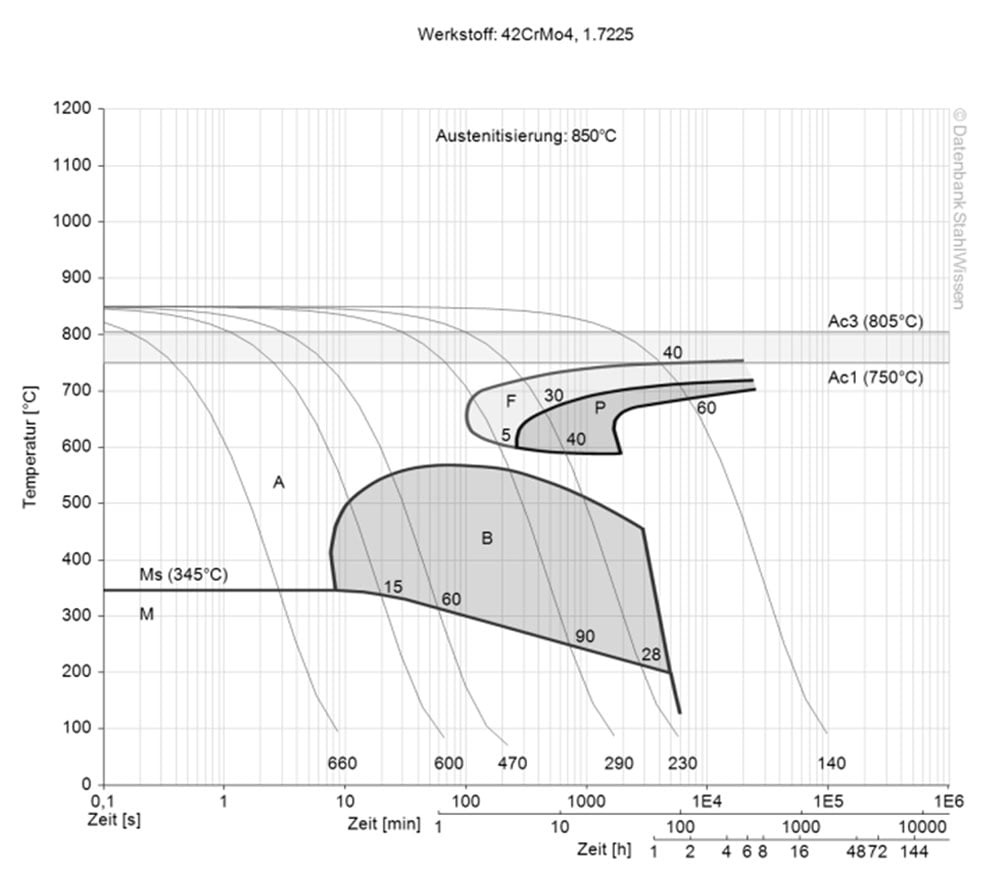
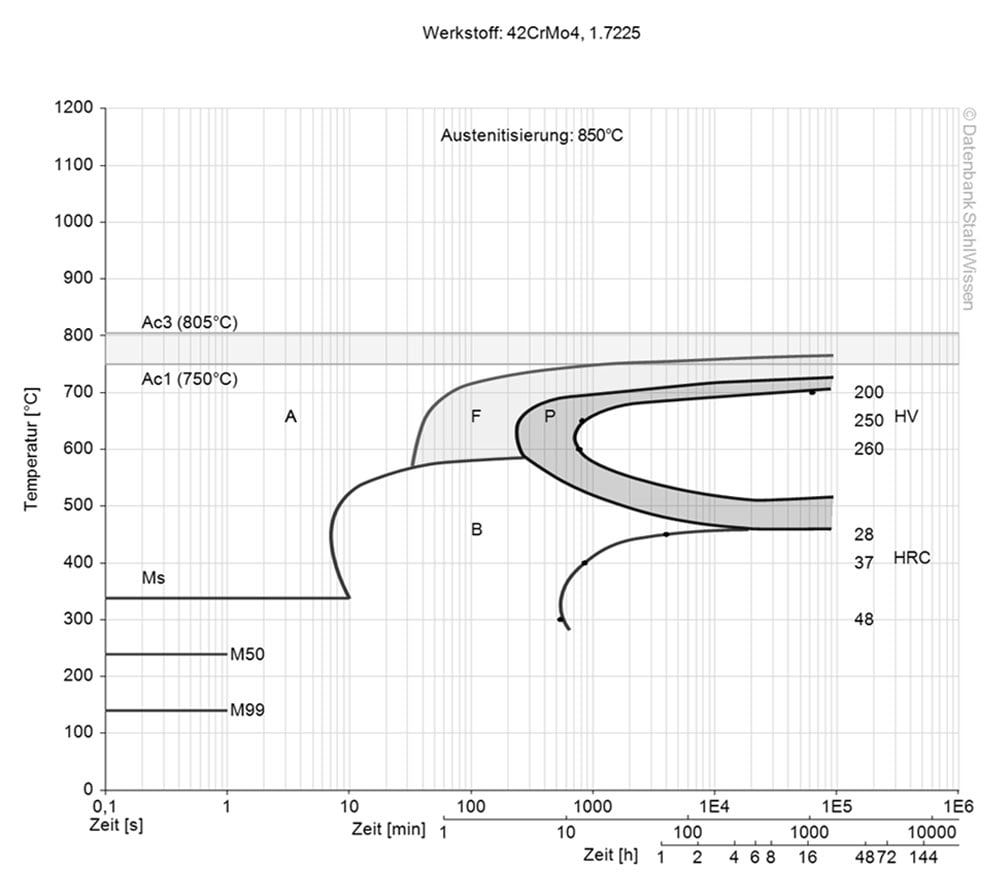
1.7225+QT Continous TTT-diagram
This diagram shows mirco changes over time at different temperatures. This can be important during heat treatment as it provides information about the optimal conditions for processes such as hardening, annealing and normalising.
1.7225+QT Isothermal TTT-diagram
This diagram shows the structural changes at the micro level over time at a constant temperature. It shows at what temperature and after what time different phases, e.g. perlite, martensite or bainite, begin to form.
1.7225+QT Surface treatment
1.7225+QT Nitriding
1.7225+QT can be nitrided to give this steel grade a harder surface layer. During nitriding, nitrogen is diffused into the surface to give the material a harder surface and/or improved corrosion resistance, for example.
1.7225+QT Processing
After heat treatment, grade 1.7225+QT acquires a microstructure that is necessary for this material to be easily machined.
1.7225+QT Electrical Discharge Machining (EDM)
It is possible to erode this type of steel in the annealed and hardened state. After eroding, the recast layer, a thin white layer, should be removed by grinding and polishing, otherwise this may affect the service life and performance of the workpieces.
1.7225+QT Forging
1.7225+QT can be forged in a temperature range of 900 – 1000 °C, followed by very slow cooling in still air or sand.
1.7225+QT Welding
Welding may only be carried out in the annealed or normalised condition, which is then possible using all conventional techniques. Preheat to 177 – 350 °C to prevent cracks. Due to the carbon content of this steel, preheating and post-heating is recommended. Allow to cool slowly to prevent or reduce embrittlement. If welding is carried out in the heat-treated state, which is normally only done for repairs, the mechanical properties are impaired and heat treatment should be carried out after welding. When welding preheated workpieces, it is recommended to stress relieve the parts beforehand at a temperature 15 °C below the original tempering temperature to avoid cracks.